
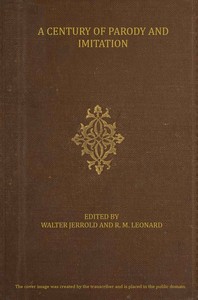
A Century of Parody and Imitation by Walter Jerrold and R. M. Leonard
Let's be clear from the start: this isn't a novel with a plot. There's no hero's journey or murder to solve. Instead, think of it as a massive, wonderfully curated scrapbook. Jerrold and Leonard have pulled together a century's worth of writing where authors imitated, mocked, and celebrated each other's work. You'll find poets rewriting other poets' famous verses, novelists penning scenes in the unmistakable style of their rivals, and satirists crafting pieces that are loving tributes and sharp critiques all at once.
The Story
The 'story' is the evolution of a literary game. The book is organized to show you how this practice of parody and imitation changed from the early 1800s to the early 1900s. You'll see how writers tackled the towering figures of their day. Someone takes a famous, serious poem by Wordsworth and gives it a silly, everyday twist. Another writer perfectly mimics the dense, dramatic style of Thomas Carlyle to talk about something trivial. It's a tour through an era, guided by the writers who were having the most fun with words.
Why You Should Read It
I loved this book because it makes literature feel alive and connected. It shows that even the most revered writers were part of a conversation—sometimes a friendly one, sometimes a bit of a roast. Reading a perfect parody requires you to understand the original, so in a way, you're getting a two-for-one lesson in style. It's also just genuinely funny. There's a special joy in recognizing the tune of a famous poem, only to find the words have been swapped out for something absurd. It reminds you that these 'classic' authors weren't untouchable statues; they were people whose work could be engaged with, played with, and yes, made fun of.
Final Verdict
This book is a gem for a specific kind of reader. It's perfect for literature lovers who already have a baseline knowledge of 19th-century poets and novelists. You'll get more out of the jokes if you're familiar with the source material. It's also great for writers interested in style and voice, showing the mechanics of imitation in action. If you're looking for a straight history or a page-turning narrative, look elsewhere. But if you want to spend time in a room where literary giants are being gently (and not-so-gently) teased, this collection is a delightful, unique read.
This content is free to share and distribute. Share knowledge freely with the world.
Kenneth Harris
1 year agoThe index links actually work, which is rare!
Karen Ramirez
1 year agoFive stars!
Joshua Ramirez
1 year agoHaving read this twice, it provides a comprehensive overview perfect for everyone. A true masterpiece.
Liam White
1 year agoSurprisingly enough, the narrative structure is incredibly compelling. Exactly what I needed.
George Jones
2 months agoHaving explored several resources on this, I find that the step-by-step breakdown of the methodology is extremely helpful for students. I feel much more confident in my knowledge after finishing this.