
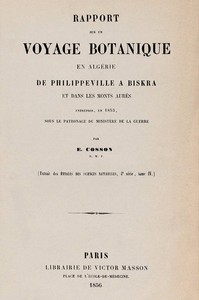
Rapport sur un voyage botanique en Algérie, de Philippeville à Biskra et dans…
Published in 1853, this book is Ernest Cosson's official report on a plant-collecting expedition he undertook the previous year. But it reads like a detailed travelogue. The journey starts in the coastal city of Philippeville (modern Skikda) and pushes south, across the Tell Atlas mountains and into the northern fringes of the Sahara, ending at the desert oasis of Biskra.
The Story
There isn't a plot in the traditional sense. Instead, the narrative is driven by the route itself. Cosson meticulously documents each leg of his trip: the changing landscapes, the villages he passes through, and, of course, the plants. He lists species—some familiar, many new to European science—describing where they grow and how they look. But the story expands far beyond botany. He writes about the practical challenges of travel in a land with few roads, his interactions with Arab and Berber communities, and the visible aftermath of the recent French conquest. He notes ancient Roman ruins sitting alongside newer settlements, painting a picture of a land with deep, layered histories. The journey is the story—a slow, observational walk through a country in a state of dramatic transition.
Why You Should Read It
What makes this special is the unique perspective. Cosson is a scientist, not a soldier or a politician. His primary lens is botanical, which gives his observations a strange neutrality. He's not (overtly) justifying colonization; he's trying to understand the landscape's natural inventory. This focus lets you see the ordinary details of 1850s Algeria—the agriculture, the architecture, the state of the roads—that often get lost in grand historical narratives. You feel the dust, the heat, and the wonder of discovery. It's a quiet book that speaks volumes about the moment it captures. Reading it, you become his companion, sharing in the small triumphs of finding a rare flower and the constant negotiation of traveling in an unfamiliar world.
Final Verdict
This isn't a beach read. It's for the curious traveler, the history enthusiast who likes primary sources, or anyone interested in the history of science and exploration. If you enjoyed the quiet observation of works like Robert Macfarlane's nature writing or the historical texture of a book like The Professor and the Madman, you'll find a similar, if older, charm here. Perfect for readers who want to time-travel via a forgotten field report and see a pivotal place and time through the uniquely focused eyes of a plant collector.
This digital edition is based on a public domain text. Feel free to use it for personal or commercial purposes.
Christopher Wright
1 year agoAmazing book.
Charles Nguyen
2 months agoAmazing book.



Kenneth Moore
2 years agoWithout a doubt, it provides a comprehensive overview perfect for everyone. One of the best books I've read this year.