
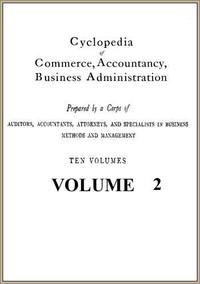
Cyclopedia of Commerce, Accountancy, Business Administration, v. 02 (of 10)
Let's be clear: this is not a novel. Cyclopedia of Commerce, Accountancy, Business Administration, Volume 2 is exactly what the title says—a deep, systematic course in the fundamentals of early 20th-century business practice. Published by the American School of Correspondence, it was designed to be mailed to students' homes. They'd read a lesson, complete exercises, and mail them back for grading. This volume continues the foundational work, diving deeper into accounting principles, commercial law, office management, and the mechanics of sales and transportation that kept the economy moving.
The Story
There's no plot in the traditional sense. The 'story' here is the unfolding of a complete professional education. It moves logically from concept to concept, building a framework for how to run a business in the pre-computer age. You follow the path a student of 1910 would have taken, learning about ledger posting, partnership agreements, warehouse receipts, and the organization of a corporate office. The narrative is one of progress and mastery, aimed at giving the reader a tangible, employable skill set.
Why You Should Read It
I found this absolutely captivating as a look into the past. It's easy to romanticize history, but this book shows the unglamorous, day-to-day work required to build an economy. The language is formal but clear, and the assumptions about the world are a history lesson in themselves. You see what they valued (precision, integrity, systematic thinking) and the tools they had to work with. Reading it feels like sitting at a desk in a quiet, wood-paneled office, learning a trade that could change your life. It’s a powerful reminder of the American drive for self-improvement.
Final Verdict
This is a niche read, but a rewarding one. It's perfect for history enthusiasts, business professionals curious about their field's roots, or writers seeking authentic period detail. If you love primary sources and seeing how things actually worked, you'll be fascinated. If you're looking for a thrilling narrative, look elsewhere. But as a window into the pragmatic mind of a bygone era and the birth of modern business education, it's utterly unique.
You are viewing a work that belongs to the global public domain. Access is open to everyone around the world.
Barbara Thompson
2 years agoThe citations provided are a goldmine for further academic study.
Susan Jones
6 months agoI was particularly interested in the case studies mentioned here, the argument presented in the middle section is particularly compelling. I feel much more confident in my knowledge after finishing this.
Robert Jackson
2 months agoBefore I started my latest project, I read this and the author doesn't just scratch the surface but goes into meaningful detail. I appreciate the effort that went into this curation.
Paul Thomas
4 months agoAs a professional in this niche, the author’s unique perspective adds a fresh layer to the discussion. A trustworthy resource that I'll keep in my digital library.




Thomas Perez
3 months agoIt took me a while to process the complex ideas here, but the case studies and practical examples provided add immense value. I'll be recommending this to my students and colleagues alike.