
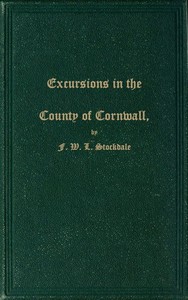
Excursions in the County of Cornwall by Frederick Wilton Litchfield Stockdale
Let's be clear from the start: Excursions in the County of Cornwall is not a novel. You won't find a twisting plot or dramatic dialogue. Instead, think of it as following a very determined, slightly eccentric uncle on a long walking tour. The 'story' is Stockdale's journey. He methodically travels from parish to parish in the early 19th century, acting as part surveyor, part historian, and part cheerleader for a region he clearly loves.
The Story
The book is structured as a series of letters or journal entries from his travels. He describes the lay of the land, the state of the roads (often terrible), and the industries he finds, from tin mining to fishing. But he goes deeper. He seeks out ancient monuments, records local customs that were already fading, and transcribes inscriptions from church walls. The narrative drive comes from his relentless curiosity. He wants to measure, catalog, and understand every hill, creek, and village. The 'plot' is simply the unfolding of Cornwall itself through his observant eyes.
Why You Should Read It
What makes this old book special is Stockdale's voice. He's not a dispassionate observer. You can feel his frustration when a beautiful medieval cross is being used as a gatepost, and his delight when a farmer shares a old story about the local 'giant's grave.' He argues with the popular guidebooks of his day, insisting they've missed the real Cornwall. Reading it today, it becomes a double history lesson: you learn about Cornwall in the 1820s, but you also get a brilliant snapshot of how people thought about history and place 200 years ago. It’s a quiet, thoughtful protest against forgetting.
Final Verdict
This is a niche read, but a rewarding one. It's perfect for history buffs, amateur genealogists with Cornish roots, or anyone who loves slow travel and landscape writing. If you've ever visited Cornwall and felt the pull of its ancient magic, Stockdale is your ideal companion. He saw that magic two centuries ago and worked hard to pin it to the page. It's not a breezy beach read; it's a companion for a rainy afternoon, best enjoyed with a map of Cornwall and a cup of tea. You come away feeling like you've been given a key to a hidden door in the cliffs.
You are viewing a work that belongs to the global public domain. Use this text in your own projects freely.
George Gonzalez
1 year agoThe clarity of the introduction set high expectations, and the chapter on advanced strategies offers insights I haven't seen elsewhere. Well worth the time invested in reading it.
Karen White
2 years agoThis was exactly the kind of deep dive I was searching for, the clarity of the writing makes even the most dense sections readable. Well worth the time invested in reading it.
Margaret Rodriguez
2 years agoThe clarity of the concluding remarks is very professional.
Ashley Jones
1 year agoMy first impression was quite positive because the formatting on mobile devices is surprisingly crisp and clear. Definitely a five-star contribution to the field.


Mary Lee
1 year agoA must-have for graduate-level students in this discipline.