
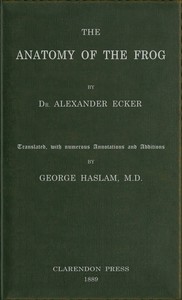
The anatomy of the frog by Alexander Ecker
Let's be clear from the start: this is not a novel. You won't find any characters or a twisting plot. Instead, The Anatomy of the Frog is exactly what the title promises—a detailed, systematic guide to the physical structure of a common frog. Published in the mid-1800s, it represents a massive effort to catalog and understand a creature most people would just step over.
The Story
Think of it less as a story and more as a guided tour. Ecker acts as your methodical guide, leading you through the frog's body system by system. He starts with the external features—the skin, the eyes, the limbs—before moving inward. He describes the bones and muscles that allow it to jump, the intricate network of nerves, the digestive system, and, with particular care, the heart and circulatory system. Each part is examined, named, and its function explained based on the knowledge of the era. The "narrative" is the journey of discovery itself, moving from the whole organism down to its smallest components.
Why You Should Read It
I loved this book for its quiet intensity. Ecker's writing isn't flashy, but his deep focus is captivating. You get a real sense of the patience required for science before photography or digital models. His descriptions are so precise you can almost see him pointing with a scalpel. Reading it today is a dual experience: you learn a lot about frog biology, but you also learn about the history of science. You see what questions scientists were asking 150 years ago and how they went about answering them with careful observation and hand-drawn illustrations. It’s a powerful reminder that all our modern knowledge is built on foundational works like this one.
Final Verdict
This book is a niche gem. It's perfect for history of science enthusiasts, biology students curious about foundational texts, or anyone with a love for beautifully detailed natural history. It's also great for readers who enjoy primary sources and seeing how ideas were communicated in a different time. If you need a fast-paced plot or casual reading, this isn't it. But if you're in the mood for a slow, thoughtful, and genuinely educational look at how we began to understand the complex world right under our feet, Ecker's frog is a wonderful place to start. It turns simple curiosity into an act of profound exploration.
This masterpiece is free from copyright limitations. It is available for public use and education.
Ethan Taylor
1 year agoThe fonts used are very comfortable for long reading sessions.
Noah Young
1 year agoIf you enjoy this genre, the content flows smoothly from one chapter to the next. Definitely a 5-star read.
Mark Taylor
1 year agoGreat read!
Joseph Sanchez
2 years agoFinally found time to read this!




Linda Thompson
1 year agoMy professor recommended this, and I see why.