About 154 minutes
Nonsense Novels — Key Ideas to Explore
Historical Psychological Social Fiction
35,355 recorded words. 42 minutes difference from this book's estimate.
View Gutenberg source #4682
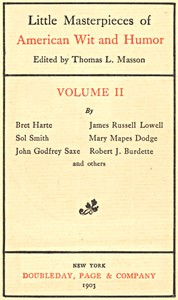
The catalog record for Little Masterpieces of American Wit and Humor, Volume II — Text and Context provides practical reading context through 44,941 words, 3 hr 16 min estimated reading time, and 6 detected text sections.
The text analysis averages about 20.2 words per sentence, while the detected sections provide another way to judge how the source is divided.
Project Gutenberg metadata also associates the work with “American wit and humor,” connecting these edition facts with the source record’s subject description.
Explore this collection
These alternatives are selected using recorded categories and estimated reading time.
About 154 minutes
Historical Psychological Social Fiction
35,355 recorded words. 42 minutes difference from this book's estimate.
View Gutenberg source #4682About 146 minutes
Historical Psychological Social Fiction
33,541 recorded words. 50 minutes difference from this book's estimate.
View Gutenberg source #68468About 144 minutes
Historical Psychological Social Fiction
33,048 recorded words. 52 minutes difference from this book's estimate.
View Gutenberg source #23449Search stored excerpts and compare books → Choose by your preferences →
Choices use stored catalog measurements. Estimates vary with reading speed. A shared category is a catalog label, not a claim that two books have the same argument or literary quality.
Search reads excerpt text stored with this catalog and links to its associated Gutenberg record. The connection is stored in the site database; this tool does not recheck that every excerpt is word-for-word identical to that external record. Excerpt search does not cover every chapter and does not verify historical publication dates.
Catalog snapshot checked: 2026-09-25. Coverage: 91 public books, 91 available source excerpts.
Read the complete public-domain text at its original source.
Read on Project GutenbergThe second volume of Thomas L. Masson's anthology gathers twenty-six pieces that span the comic range of nineteenth-century American letters. The collection opens with Sol Smith's steamboat yarn, a tall tale that sets a leisurely, anecdotal pace, and moves through Oliver Wendell Holmes's elaborate, mock-scholarly complaint about a boring uncle. The excerpts reveal a deliberate variety in narrative voice: Smith's colloquial, first-person storytelling contrasts with Holmes's ornate, digressive prose, while later entries like Frank R. Stockton's 'Pomona's Novel' and Bill Nye's 'A Fatal Thirst' shift toward tighter, more situational humor. Masson's selection emphasizes how each author manipulates tempo—whether through drawn-out descriptions, sudden punchlines, or rhythmic dialogue—to achieve comic effect.
Sol Smith's 'A Bully Boat and a Brag Captain' exemplifies the leisurely, cumulative style of the Mississippi tall tale. The narrator recounts the steamboat Caravan's slow progress with deadpan exaggeration: a five-day trip from New Orleans to Natchez was 'considered remarkable,' and a voyage to Vicksburg might earn the crew a month's wages. Smith builds humor through patient, circumstantial detail—the low wood supply, the captain's fondness for the card game brag—before delivering a payoff that depends on the reader's patience. This unhurried accumulation contrasts sharply with the compressed, epigrammatic wit of John Godfrey Saxe's 'The Coquette—A Portrait,' a short poem that sketches a character in a few lines. The volume thus offers a spectrum of pacing, from expansive storytelling to concise, punchy forms.
Oliver Wendell Holmes's 'Dislikes' demonstrates a sophisticated, mock-eloquent voice that turns a personal grievance into a comic essay. The narrator describes his uncle as 'a bore—a BORE! of the most malignant type,' and the humor arises from the gap between the trivial subject and the grandiose, literary language. Holmes employs elaborate metaphors—the uncle's sermons as a 'spiritual sponge' that 'sucks and sucks and sucks'—and allusions to Macbeth and Lamb to inflate the complaint. This rhetorical playfulness is a different kind of humor from the plain-spoken irony of Ambrose Bierce's 'The Dog and the Bees,' a very short fable that relies on understatement and a twist. Masson's selection highlights how voice itself—whether ornate or clipped—shapes the comic effect.
The collection showcases a range of structural approaches to humor. Mary Mapes Dodge's 'Miss Malony on the Chinese Question' uses a dialect monologue, with the Irish-American speaker's voice carrying the comedy through its distinctive rhythm and perspective. In contrast, James Russell Lowell's 'The Courtin'' is a narrative poem in dialect that builds a gentle romantic plot through stanza-by-stanza progression. Bret Harte's 'Melons' and 'The Society upon the Stanislaus' employ the short-story form with a more developed narrative arc, while George T. Lanigan's 'The Fox and the Crow' is a brief, pointed parody. This structural diversity—from the loose anecdote to the tight poem to the dramatic monologue—means that the reader encounters constant shifts in form, which keeps the anthology engaging and demonstrates the breadth of American comic writing in the period.
Because the excerpts are incomplete, the full arc of each piece—and the overall editorial logic of the volume—remains partially obscured. Readers should attend to how each author establishes a comic premise and whether the humor depends on situation, character, or verbal play. The anthology rewards attention to the different speeds of wit: some pieces ask for patience, others for quick recognition. Comparing the opening strategies of the longer prose selections with the brevity of the poems and epigrams can reveal much about the craft of nineteenth-century American humor.
There’s something about those old witty voices—Twain’s dry wink, Holmes’s gentle ribbing—that stays with you long after the page turns. I found myself thinking of that quiet humor again while browsing through Knocking the Neighbors — Themes and Context, where the same neighborly teasing feels oddly familiar, like a shared chuckle between friends, unhurried and warm.
Use these questions to collect your thoughts before moving on.