About 1,195 minutes
Parodies of the works of English & American authors, vol. V — Reading Companion
Historical Psychological Social Fiction
274,751 recorded words. 236 minutes difference from this book's estimate.
View Gutenberg source #70547
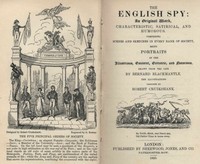
This digital edition of The English Spy: An Original Work Characteristic, Satirical, And Humorous. Comprising Scenes And Sketches In Every Rank Of Society, Being Portraits Drawn From The Life — A Closer Reading is described by source-level measurements including 220,378 words, 15 hr 59 min estimated reading time, and 32 detected text sections.
The text analysis averages about 31.3 words per sentence, while the detected sections provide another way to judge how the source is divided.
Project Gutenberg metadata also associates the work with “Satire, English,” connecting these edition facts with the source record’s subject description.
Explore this collection
These alternatives are selected using recorded categories and estimated reading time.
About 1,195 minutes
Historical Psychological Social Fiction
274,751 recorded words. 236 minutes difference from this book's estimate.
View Gutenberg source #70547About 705 minutes
Historical Psychological Social Fiction
161,958 recorded words. 254 minutes difference from this book's estimate.
View Gutenberg source #6053About 642 minutes
Historical Psychological Social Fiction
147,565 recorded words. 317 minutes difference from this book's estimate.
View Gutenberg source #1081Search stored excerpts and compare books → Choose by your preferences →
Choices use stored catalog measurements. Estimates vary with reading speed. A shared category is a catalog label, not a claim that two books have the same argument or literary quality.
Search reads excerpt text stored with this catalog and links to its associated Gutenberg record. The connection is stored in the site database; this tool does not recheck that every excerpt is word-for-word identical to that external record. Excerpt search does not cover every chapter and does not verify historical publication dates.
Catalog snapshot checked: 2026-09-25. Coverage: 91 public books, 91 available source excerpts.
Read the complete public-domain text at its original source.
Read on Project GutenbergThe English Spy opens with a mock-heroic preface and a table of contents that reads like a rollicking itinerary: from Eton Montem and Oxford wine parties to Brighton beach and the Coal Hole Tavern. The narrator, Bernard Blackmantle, presents himself as a roving observer of “every rank of society,” and the early pages establish a pattern of mixing verse quotations with prose anecdotes. The first substantial scene, set in a debtors’ prison, introduces a character named Echo who is “safely tiled in at ten in twelve” and subjected to a blanket-tossing. The tone is jocular, but the satire has a sharp edge: a “poor little limb of the law” is described as having “ratted” on old cronies. The illustrations by Robert Cruikshank are integral, with plates referenced in the text (e.g., “see plate”) and the digital edition includes them as full-size images.
The text alternates between narrative prose, quoted poetry, and original verse. The preface is “in imitation of satire of Persius,” and the contents include odes, an “Epistle to Bernard Blackmantle,” and a “Shandean Scene.” The excerpts show the author weaving lines from other poets—such as “Thou seest thou neither art mark’d out or named” from Withers—into his own descriptions. This technique creates a layered, allusive texture that rewards attention to the sources. The reader should expect sudden shifts: a paragraph of detailed observation may be followed by a stanza of moralizing verse. The effect is cumulative, building a portrait of society through juxtaposition rather than linear plot.
The locations are carefully chosen for their social resonance. Eton and Oxford appear in the first volume, with sketches of “The Freshman,” “College Servants,” and “Town and Gown, an Oxford Row.” Later sections move to London’s Coal Hole Tavern, described as “one of the best and cheapest ordinaries,” where “actors, authors, reporters, clerks” mingle. The prison scene in Banco Regis offers a glimpse of “the customs of the place” and “the lavish waste, the riot, and excess.” Each setting is rendered with specific details—the tavern’s host “Rhodes himself is a punster and a poet”—that ground the satire in recognizable contemporary institutions. The reader should note how the physical spaces (a prison room, a dining table, a beach) become stages for social critique.
The figures in The English Spy are less developed personalities than types or caricatures, often identified by nicknames: “Echo,” “Transit,” “Bernard Blackmantle” himself. The excerpts show them acting in brief, emblematic scenes: Echo is “gay-hearted” and imprisoned for debt; Transit is an art student who tries to get the narrator into the Life Academy. The author uses these figures to illustrate broader social vices—debt, hypocrisy, pretension. The illustrations by Cruikshank reinforce this approach, with plates that “introduce the portraits of several well-known academicians.” The reader should treat each character as a representative of a class or profession, not as a protagonist with an arc. The humor depends on recognizing the type.
The title’s “Spy” is a framing device: Bernard Blackmantle claims to observe and report on society. The preface addresses “the Reviewers,” and the text includes direct addresses to the reader, such as “you must therefore be content with his sketch.” This self-consciousness invites the reader to become a co-observer, decoding the allusions and recognizing the real-world counterparts of the caricatures. The digital edition’s table of contents lists 32 sections, suggesting a episodic structure. The reader should approach the work as a series of sketches to be sampled, not a continuous narrative. The illustrations are essential; the text often refers to them, and the digital format allows for enlargement. The experience is akin to flipping through a satirical magazine of the 1820s.
For a first reading, begin with the table of contents to choose a section that interests you—perhaps the Eton scenes or the London tavern sketches. The work rewards browsing over linear reading. Pay attention to the footnotes and quoted poems, which often carry the satirical weight. The illustrations by Robert Cruikshank are not decorative but integral to the meaning; view them alongside the text. The English Spy is a product of its time, and its references to forgotten scandals and institutions may require patience, but its energy and wit remain accessible.
Leafing through Blackmantle’s sketches of London’s rowdy taverns, I found myself smiling at how effortlessly he drifts from sharp observation to sheer tomfoolery. It reminded me of that old friend who never quite outgrew his mischief. The same sly wink hides between the lines of Further nonsense verse and prose — Text and Context, a quieter, slightly familiar echo of that same unruly spirit.
A brief reflection can help important ideas stay with you longer.