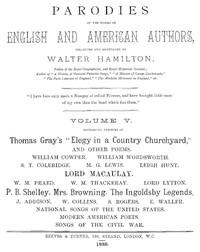
Walter Hamilton's fifth volume of Parodies of the Works of English & American Authors (1888) assembles over 270,000 words of burlesque and imitation, targeting poets from Thomas Gray to American Civil War songwriters. The compiler, a Fellow of the Royal Geographical Society, frames his project with Montaigne's metaphor: 'I have here only made a Nosegay of culled Flowers, and have brought little more of my own than the band which ties them.' The introduction thanks contributors including E. B. Anstee, Cuthbert Bede, and G. R. Sims, and emphasizes the work's reliability as 'a book of reference on Parody and Burlesque.'
Macaulay's Lays Recast
The volume contains multiple parodies of Thomas Babington Macaulay's Lays of Ancient Rome, a favorite target for Victorian humorists. One example, 'The Lay of the Last Commemoration Dinner,' transforms the martial rhythm of 'Horatius' into a Cambridge college feast: 'The Seniors of Trinity / By Newton's bones they swore, / That the proud Undergraduate / Should share the feast no more.' The parody escalates from exclusion to explosive revenge, with a freshman named Tomkins blowing up the dons' banquet. Another piece, 'Obstruction Utilised,' recasts the same meter as a satire of British colonial politics, replacing Horatius with Charles Parnell obstructing King Mensa of Coomassie: 'For England in her battles / Grudged not a Home Rule life.' A prose burlesque from Christ's Hospital, 'How Horatius kept the Bridge,' includes verse snippets like 'When the face of Sextus / Was seen among the foes, / No blackguard in the city / But raised his Roman nose.' These examples show how Macaulay's heroic cadence was repurposed for academic, political, and schoolboy humor.
Gray's Elegy as a Parody Template
Hamilton devotes a substantial section to parodies of Thomas Gray's 'Elegy Written in a Country Churchyard,' a poem whose solemn quatrains proved adaptable to comic and satirical ends. The volume collects numerous imitations that replace Gray's rural meditations with contemporary subjects, though the excerpts do not reproduce the full texts. The compiler's method is evident: he traces each parody to its original source, names the author where possible, and provides contextual notes. The 'Elegy' parodies likely transpose Gray's 'curfew tolls the knell of parting day' into settings ranging from urban streets to political arenas. Hamilton's annotation style—acknowledging permissions and crediting contributors—suggests a scholarly rigor unusual for a humor anthology. The inclusion of Gray's poem as a recurring target indicates its cultural ubiquity in the late nineteenth century, when even a churchyard meditation could be turned to laughter.
American Voices and Civil War Songs
The volume's scope extends to 'National Songs of the United States,' 'Modern American Poets,' and 'Songs of the Civil War,' reflecting Hamilton's transatlantic reach. The excerpts do not specify which American poets are parodied, but the catalog lists Addison, Collins, Rogers, and Waller alongside American entries. The Civil War songs likely include parodies of 'The Battle Hymn of the Republic' or 'Dixie,' recast for political or comic effect. Hamilton's introduction thanks American contributors such as J. G. Dalton of Boston and F. B. Perkins of San Francisco, indicating active transatlantic correspondence. The inclusion of American material broadens the collection beyond British literature, making it a comparative study of parody across cultures. The compiler's note that 'no trouble has been spared to obtain every parody worth quoting' suggests a comprehensive ambition, though the excerpts give only glimpses of the American section's contents.
Readers approaching this volume should attend to Hamilton's annotations, which often supply the original poem's title and the parodist's name. The collection rewards browsing: a single page may juxtapose a Cambridge dinner satire with an Ashanti war burlesque. The editor's framing—as a 'nosegay' of borrowed flowers—invites readers to compare each parody with its source, noticing how meter, diction, and subject are twisted. The volume is best used as a reference, dipping into sections of interest rather than reading straight through.
This collection made me remember a rainy afternoon, laughing at how tenderly the poets mocked their own seriousness. It felt like sitting with friends who know each other too well to be cruel. The Story of an Ostrich: An Allegory and Humorous Satire in Rhyme. — Background and Themes once gave me that same warmth—a gentle joke wrapped around a truth, leaving a quiet ache behind.