About 605 minutes
A Blundering Boy: A Humorous Story — Background and Themes
Historical Psychological Social Fiction
139,098 recorded words. 37 minutes difference from this book's estimate.
View Gutenberg source #54367
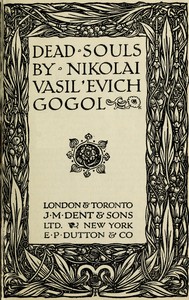
Dead Souls — Inside the Classic can be approached with a clearer sense of reading commitment from its source measurements: 147,565 words, 10 hr 42 min estimated reading time, and 15 detected text sections.
The text analysis averages about 20.8 words per sentence, while the detected sections provide another way to judge how the source is divided.
Project Gutenberg metadata also associates the work with “Satire,” connecting these edition facts with the source record’s subject description.
Explore this collection
These alternatives are selected using recorded categories and estimated reading time.
About 605 minutes
Historical Psychological Social Fiction
139,098 recorded words. 37 minutes difference from this book's estimate.
View Gutenberg source #54367About 705 minutes
Historical Psychological Social Fiction
161,958 recorded words. 63 minutes difference from this book's estimate.
View Gutenberg source #6053About 512 minutes
Historical Psychological Social Fiction
117,677 recorded words. 130 minutes difference from this book's estimate.
View Gutenberg source #58070Search stored excerpts and compare books → Choose by your preferences →
Choices use stored catalog measurements. Estimates vary with reading speed. A shared category is a catalog label, not a claim that two books have the same argument or literary quality.
Search reads excerpt text stored with this catalog and links to its associated Gutenberg record. The connection is stored in the site database; this tool does not recheck that every excerpt is word-for-word identical to that external record. Excerpt search does not cover every chapter and does not verify historical publication dates.
Catalog snapshot checked: 2026-09-25. Coverage: 91 public books, 91 available source excerpts.
Read the complete public-domain text at its original source.
Read on Project GutenbergFrom its first chapter, Dead Souls establishes a narrator who is both observer and commentator, frequently breaking the flow of action to address the reader directly. This narrative voice is not consistent: it can be wryly detached when describing the provincial governor's party, then suddenly earnest in a lyrical passage about the Russian landscape. The effect is a deliberate unevenness in pace, as the story lurches from brisk, comic scenes of Chichikov's negotiations to slow, meditative asides. Gogol's prose, in D. J. Hogarth's translation, often piles up minute details—a character's habits, the decor of a room—before pulling back to a broader, almost philosophical view. This technique keeps the reader alert to shifts in tone, but also mirrors the fragmentary nature of the work itself, which survives as a complete first part and a partial second part.
The narrator of Dead Souls is a character in his own right, one who does not hesitate to step forward and address the reader. Early in the text, after introducing Chichikov's arrival, the narrator pauses to remark on the difficulty of portraying a hero who is not virtuous. This direct commentary recurs throughout, sometimes to apologize for a digression, sometimes to moralize. For example, when describing the swindler's smooth manners, the narrator interjects with a wry observation about the social acceptance of rogues. These interruptions create a stop-start rhythm: the plot advances, then halts while the narrator reflects. The tone also shifts abruptly. A scene that begins as farce—such as the description of a landowner's absurd habits—can slide into a somber meditation on mortality or the Russian soul. This tonal volatility is a hallmark of Gogol's style, and it prevents the reader from settling into a single mood.
Gogol often slows the narrative to a crawl by amassing concrete, sometimes trivial details about characters and settings. In the excerpt describing the landowner Manilov, the narrator lists his pleasant but vague features, the furnishings of his house, and his habit of smiling too much. The accumulation builds a portrait, but it also delays the action. Similarly, the tale of Captain Kopeikin—a story within the story—unfolds with a leisurely, almost oral quality, piling up specifics about the captain's wooden leg, his wait at the commission, and his subsequent spending spree. The pace here is deliberately unhurried, mimicking the rambling style of a spoken anecdote. Yet these detailed passages are punctuated by moments of swift summary, where the narrator covers weeks in a sentence. The result is a narrative that feels both expansive and digressive, with the reader often unsure whether the next paragraph will linger or leap forward.
The text as it survives is incomplete: Part I ends with a chapter that shifts into a lyrical, almost epic register, while Part II breaks off mid-scene. This fragmentary structure affects the reading experience. The narrator's voice, which had been chatty and satirical, becomes more somber and philosophical in the final chapters of Part I, as if the author were reaching for a conclusion that never came. The pace slows further in the surviving portions of Part II, where the narrative seems to be searching for a new direction. The preparer's note warns that pages are missing from the Russian original, so the reader encounters gaps and abrupt transitions. These are not flaws but features of the work's history: the unfinished quality mirrors the open-endedness of Chichikov's schemes. The reader must accept that the story will not resolve neatly, and that the narrator's final words—whatever they may be—will remain provisional.
Readers approaching Dead Souls should be prepared for a narrative that resists smooth progression. The voice of the narrator is the true protagonist, and his digressions, moral asides, and shifts in register are as important as the plot. Pay attention to how Gogol uses pace: when he slows down to describe a room or a meal, he is often building a satirical portrait; when he speeds up, he may be rushing past something he finds uncomfortable. The incomplete state of the work is not a defect but an invitation to consider what a finished version might have been—and to enjoy the strange, uneven journey that remains.
There are moments in Dead Souls, between the swindling and the satire, where Gogol simply stops and gazes at the Russian landscape, and I felt that same unhurried breath in Home Life in Russia, Volumes 1 and 2 [Dead Souls] — Context and Discussion. It reminded me of evening light on an empty road—not going anywhere, just resting on the familiar. Something quieter lingered between those lines, like the ghost of a story I barely knew.
Answer a few questions and save a private reflection on this device.