About 605 minutes
A Blundering Boy: A Humorous Story — Background and Themes
Historical Psychological Social Fiction
139,098 recorded words. 93 minutes difference from this book's estimate.
View Gutenberg source #54367
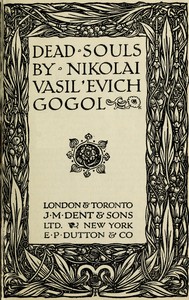
![Cover of Home Life in Russia, Volumes 1 and 2 [Dead Souls] — Context and Discussion](https://eulol.com/storage/media/covers/pg58070.jpg)
Home Life in Russia, Volumes 1 and 2 [Dead Souls] — Context and Discussion can be approached with a clearer sense of reading commitment from its source measurements: 117,677 words, 8 hr 32 min estimated reading time, and 10 detected text sections.
The text analysis averages about 28.0 words per sentence, while the detected sections provide another way to judge how the source is divided.
Project Gutenberg metadata also associates the work with “Satire,” connecting these edition facts with the source record’s subject description.
Explore this collection
These alternatives are selected using recorded categories and estimated reading time.
About 605 minutes
Historical Psychological Social Fiction
139,098 recorded words. 93 minutes difference from this book's estimate.
View Gutenberg source #54367About 404 minutes
Historical Psychological Social Fiction
92,822 recorded words. 108 minutes difference from this book's estimate.
View Gutenberg source #68809About 642 minutes
Historical Psychological Social Fiction
147,565 recorded words. 130 minutes difference from this book's estimate.
View Gutenberg source #1081Search stored excerpts and compare books → Choose by your preferences →
Choices use stored catalog measurements. Estimates vary with reading speed. A shared category is a catalog label, not a claim that two books have the same argument or literary quality.
Search reads excerpt text stored with this catalog and links to its associated Gutenberg record. The connection is stored in the site database; this tool does not recheck that every excerpt is word-for-word identical to that external record. Excerpt search does not cover every chapter and does not verify historical publication dates.
Catalog snapshot checked: 2026-09-25. Coverage: 91 public books, 91 available source excerpts.
Read the complete public-domain text at its original source.
Read on Project GutenbergThe 1854 English edition of Gogol's novel, here titled Home Life in Russia, arrives with a translator's preface that insists on the work's authenticity and its author's desire to return to Russia—a framing that colors every page. The catalog subjects list satire, humorous stories, and swindling, but the excerpts show a more specific mechanism: characters are defined almost entirely by their corrosive judgments of others. In the scene with Sobakevitch, Tchichikoff attempts polite conversation about local officials, only to have each one dismissed as a fool, a scoundrel, or a pig. The humor arises not from plot but from the relentless, deadpan escalation of insult.
The description of Sobakevitch's room is the most vivid passage in the excerpts. Every object is 'solid, clumsy, and tasteless in the highest degree,' and the nutwood bureau stands on 'four shapeless legs, a perfect bear.' The narrator then declares that each article seemed to say, 'I am also Sobakevitch!' This is not mere decoration; it is a structural device. Gogol uses the physical environment to externalize character, making the room a direct extension of its inhabitant's brutishness. The technique recurs in the catalog of officials: each person is reduced to a single, damning epithet, as if the novel's world were a gallery of grotesque objects. The translation preserves this bluntness, though the prose occasionally feels stiff—'paunch-bellied nutwood bureau' is a phrase that could only come from a non-native English speaker, which the preface acknowledges.
Tchichikoff's attempt to praise the Governor-General is met with Sobakevitch's flat declaration: 'He is the greatest scoundrel on the face of the earth.' When Tchichikoff cites the Governor-General's knitting and embroidery as evidence of pleasant weaknesses, Sobakevitch retorts that even his face 'is that of a scoundrel.' The pattern is mechanical: each official is introduced, praised, and then demolished. The Chief of Police is 'a rogue' who 'will sell you, betray you, and then even dine with you.' The only honest man in Smolensk, the Imperial Procurator, is 'even he is a pig.' This cascade of invective is the novel's primary mode of social commentary. It suggests a society where reputation is meaningless and all authority is corrupt—a theme that aligns with the catalog subject of 'Swindlers and swindling,' but extends beyond Tchichikoff's schemes to encompass the entire provincial elite.
The preface by Krystin Lach-Szyrma, 'Editor of Revelations of Siberia,' explicitly positions the novel as an exposé. He claims the story is 'unique' and gives 'an insight into the internal circumstances and relations of Russian society, which only a Russian could afford us.' He invokes Napoleon's dictum—'grattez le Russe, et vous trouverez Tartare'—and warns that the Nosdrieffs are 'an exceptional class, whose type is peculiar to a half-civilization.' This framing is itself a historical document: it reveals how a Victorian English audience was expected to read the novel—as a quasi-ethnographic revelation of Russian barbarism. The translator also notes that the author's name cannot be disclosed because he wishes to return to Russia, adding a layer of real-world intrigue. Readers should be aware that this preface shapes expectations, emphasizing the 'truth' of the story and its potential to 'effect some good' by exposing foibles.
The excerpts offer only a narrow window into the novel—primarily the Sobakevitch encounter and the preface. They do not reveal Tchichikoff's central scheme (purchasing dead souls) or the full range of characters. What they do show is a distinctive tonal blend: a narrator who describes furniture with deadpan precision and characters who speak in absolute, comic condemnation. The translation's occasional awkwardness—'a rogue sitting on a rogue, and driving on a batch of rogues'—adds a peculiar charm. Approach this edition as a historical artifact of cross-cultural reception as much as a satire.
I have always found a strange, quiet kinship between Gogol’s swindlers and the ostrich’s posturing. Both wear their pretensions so heavily that the feathers and the furniture become the truth. That old translation of Dead Souls sits near my desk, and beside it, I keep The Story of an Ostrich: An Allegory and Humorous Satire in Rhyme. — Background and Themes, a gentle chuckle shared across a century.
Capture what you thought, learned, and would like to remember.