About 371 minutes
Sartor Resartus: The Life and Opinions of Herr Teufelsdröckh — Reading Notes
Historical Psychological Social Fiction
85,285 recorded words. 3 minutes difference from this book's estimate.
View Gutenberg source #1051
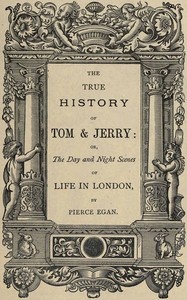
Before opening The True History of Tom & Jerry or, The Day and Night Scenes, of Life in London from the Start to the Finish! — A Closer Reading, the edition data offers a quick orientation: 85,852 words, 6 hr 14 min estimated reading time, and 11 detected text sections.
The text analysis averages about 17.2 words per sentence, while the detected sections provide another way to judge how the source is divided.
Project Gutenberg metadata also associates the work with “Humorous stories, English,” connecting these edition facts with the source record’s subject description.
Explore this collection
These alternatives are selected using recorded categories and estimated reading time.
About 371 minutes
Historical Psychological Social Fiction
85,285 recorded words. 3 minutes difference from this book's estimate.
View Gutenberg source #1051About 404 minutes
Historical Psychological Social Fiction
92,822 recorded words. 30 minutes difference from this book's estimate.
View Gutenberg source #68809About 322 minutes
Historical Psychological Social Fiction
74,004 recorded words. 52 minutes difference from this book's estimate.
View Gutenberg source #27533Search stored excerpts and compare books → Choose by your preferences →
Choices use stored catalog measurements. Estimates vary with reading speed. A shared category is a catalog label, not a claim that two books have the same argument or literary quality.
Search reads excerpt text stored with this catalog and links to its associated Gutenberg record. The connection is stored in the site database; this tool does not recheck that every excerpt is word-for-word identical to that external record. Excerpt search does not cover every chapter and does not verify historical publication dates.
Catalog snapshot checked: 2026-09-25. Coverage: 91 public books, 91 available source excerpts.
Read the complete public-domain text at its original source.
Read on Project GutenbergCharles Hindley's 1880s compilation opens not with a narrative but with a song: Billy Waters's verse celebrating 'Tom and my Jerry' and the 'precious Trio.' This immediately signals that the book is a layered document—part anthology, part history, part glossary. Hindley's introduction recounts how Egan's 'Life in London' became a phenomenon, its 'flash' slang infiltrating drawing-rooms, and how the one-legged street musician Billy Waters died in a workhouse after the craze passed him by. The excerpts show a text that constantly shifts between verse, editorial commentary, and reprinted documents, including a constable's boastful song about extorting bribes. Readers should expect a collage rather than a continuous story.
The opening lines—'Life in London, my boys, is a round of delight'—are attributed to Billy Waters, a real figure whose fate Hindley later describes. The verse establishes the trio of Tom, Jerry, and Billy as 'pals in a lark' who can 'the Town defy.' This is not a novel's exposition but a performance, complete with slang terms like 'Coves' and 'Swells.' Hindley follows the song with a stark account: Waters died in St. Giles's workhouse, whispering 'Cuss him, dam Tom—meē—Tom—meē Jerry!' The juxtaposition of jaunty rhyme and grim biography is the book's method. Readers should note how Hindley uses these contrasts to frame the original work's success as a double-edged phenomenon.
A long poem from a constable occupies a substantial excerpt. Its refrain—'And I’m a Constable, &c.'—repeats through stanzas describing bribery, selective enforcement, and petty corruption. The constable boasts of fining fruit-sellers while letting off 'gentlemen' who pay. He calls the watch-house his 'kingdom' and commits 'unfortunate gals' alongside their 'pals.' This is not a moral critique but a comic monologue in the 'flash' language that Hindley says became fashionable. The poem's inclusion shows how the original 'Life in London' mixed low-life humor with a lexicon that required a glossary—a feature Hindley promises in his subtitle. Readers encountering this constable should treat him as a type, not a character.
Hindley credits the 'thirty-six scenes from Real Life, designed and etched by the Brothers Cruikshank' as central to the work's success. He then details Pierce Egan's complaints about literary pirates who 'prig his thoughts' and 'grab all the lively things out of his head.' The language is vivid: Egan felt he received 'more of the kicks than the halfpence.' Hindley also notes the 'cry of immorality' raised by the Religious Tract Society and Methodists. This section reveals the commercial and moral battles surrounding the original publication. The excerpts do not include the illustrations themselves, but Hindley's emphasis on them suggests that the visual component was integral to the craze. Readers should imagine the Cruikshanks' etchings as a parallel text.
Hindley reproduces Egan's announcement of a sequel, 'The Finish,' written seven years after the original. Egan declares he has 'once more seized hold of the feather' and promises to 'follow the advice of our immortal bard, or rather adopt him as a model, “nothing to extenuate, or set down aught in malice!”' The tone is defensive and self-promotional. Hindley's framing suggests that the sequel was a response to both the piracy and the moral backlash. The excerpts end before any narrative from 'The Finish' appears, so readers cannot judge whether Egan succeeded. What remains is the sense of a literary phenomenon that generated its own mythology, complete with a tragic footnote in Billy Waters and a defiant author still trying to 'have another “shy-up.”'
Hindley's compilation is best approached as a scrapbook of a cultural moment. The excerpts offer no continuous plot but a series of documents—songs, editorials, poems, and advertisements—that together reconstruct the world of 'Life in London.' Readers should pay attention to the footnotes and glossary promised in the subtitle, as the slang is essential to the humor. The book rewards those who treat it as a primary source on early 19th-century London's print culture, street life, and the uneasy relationship between popular entertainment and moral reform.
What stayed with me in that Hindley book wasn’t just the slang or the prints, but how the glitter of old London faded into real lives, like Billy Waters’s quiet end. That same ache of hopeful striving turning hollow lives in The Struggles of Brown, Jones, and Robinson By One of the Firm — Story, Setting & Ideas. It lingers, not as a lesson, but as a long, slow exhale.
Capture what you thought, learned, and would like to remember.