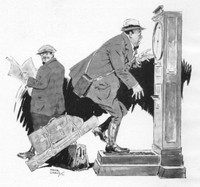
George Ade's The Slim Princess opens with a deliberately ethnographic tone, describing Morovenia as a state where 'both the mosque and the motor-car now occur in the same landscape.' This juxtaposition of old and new sets the stage for a comedy of cultural collision. The narrator explains that in Morovenia, a woman's beauty is measured by her weight—'only the fat women were irresistible'—and that the princess Kalora suffers the affliction of being slim. Ade's prose moves briskly between broad satire and precise observation, using the fictional Balkan setting to lampoon both Orientalist stereotypes and American notions of progress.
A Landscape of Contradictions
The novel's opening chapters establish Morovenia as a place of deliberate incongruities. Ade writes that 'the orthodox turn their faces toward Mecca while the enlightened dream of a journey to Paris,' and that 'men of title lately have made the pleasing discovery that they may drink champagne and still be good Mussulmans.' These details are not mere background color; they create a world where every custom is in flux. The narrator's tone is wry and detached, cataloging changes in dress—'the red slipper has been succeeded by the tan gaiter'—and in social habits, while noting that women remain 'unliberated.' This tension between visible modernization and entrenched tradition drives the plot, as the slim princess becomes a symbol of what happens when old standards meet new possibilities.
The Princess and the American
The central relationship forms through a series of miscommunications and covert messages. When the American millionaire Alexander H. Pike first encounters Kalora, the narrative shifts from broad social commentary to a more intimate, farcical mode. Pike's letter, delivered by the scholar Popova, prompts Kalora to call him 'a fool—a fool!' even as she embraces the messenger. Her written reply, urging him to leave Morovenia for his safety, is read by Pike as 'not what I would precisely term a love-letter.' Ade uses these exchanges to highlight the gap between direct American speech and the elaborate indirection required by Morovenian decorum. The scene in which Kalora dictates her response while simultaneously threatening Popova's career reveals her as both a product of her restrictive society and a clever manipulator of its rules.
Movement and Stasis in the Narrative
Ade structures the story around physical movement—Pike's arrival and departure, Kalora's limited forays outside the palace—and the static confinement of the princess. The chapter titles themselves trace a trajectory: 'He Arrives,' 'He Departs,' 'On the Wing,' 'The Home-Coming.' This pattern of coming and going mirrors the larger theme of cultural transit. The excerpts show Pike crossing borders easily, while Kalora remains behind lattices and veils. Even her act of writing a letter is a transgression, conducted under the threat of discovery. The narrator's eye for detail—the 'avenue of potted palms,' the 'transcontinental express'—grounds the comedy in specific, tangible settings, making the contrast between mobility and imprisonment concrete.
Recurring Images of Weight and Visibility
Throughout the excerpts, the princess's slimness is treated as a social defect, a source of humor, and a plot device. The opening declares that 'only the fat women were irresistible,' and Kalora's affliction is that she 'weigh[s] t...' (the text cuts off). This physical characteristic is not merely descriptive; it determines her value in the marriage market and drives her father's attempts to fatten her. Ade also plays with visibility: women must be 'veiled up to the eyes' and 'must not see the men,' yet the narrative repeatedly shows Kalora looking, peeping, and observing. The tension between being seen and being hidden—between the princess's public role and her private desires—runs through every scene. Pike's letter, which risks exposure, becomes a tangible symbol of the forbidden gaze.
Readers approaching The Slim Princess should attend to the way Ade uses the fictional Morovenia as a stage for comic misunderstandings rather than a realistic setting. The novel's humor depends on recognizing the gap between what characters say and what they mean, and on the narrator's deadpan delivery of absurd social rules. The slim princess herself is less a fully realized character than a figure caught between competing systems of value—a position that generates both satire and sympathy.
Reading about the slender princess in Morovenia, I thought of my grandmother's old photograph albums, where plumpness was a quiet family joke. That same tender absurdity of measuring worth by flesh came back to me in Kid Scanlan — Background and Themes, though its world felt closer to home. Both books remind me how strange our own ideals look when held up to a mirror.