About 91 minutes
One Third Off — Text and Context
Adventure Picaresque Fiction
20,708 recorded words. 5 minutes difference from this book's estimate.
View Gutenberg source #16197
Before opening You Should Worry Says John Henry — Themes and Context, the edition data offers a quick orientation: 21,869 words, 1 hr 36 min estimated reading time, and 3 detected text sections.
The text analysis averages about 18.6 words per sentence, while the detected sections provide another way to judge how the source is divided.
Project Gutenberg metadata also associates the work with “Humorous stories,” connecting these edition facts with the source record’s subject description.
Explore this collection
These alternatives are selected using recorded categories and estimated reading time.
About 91 minutes
Adventure Picaresque Fiction
20,708 recorded words. 5 minutes difference from this book's estimate.
View Gutenberg source #16197About 85 minutes
Adventure Picaresque Fiction
19,524 recorded words. 11 minutes difference from this book's estimate.
View Gutenberg source #42400About 84 minutes
Adventure Picaresque Fiction
19,168 recorded words. 12 minutes difference from this book's estimate.
View Gutenberg source #38146Search stored excerpts and compare books → Choose by your preferences →
Choices use stored catalog measurements. Estimates vary with reading speed. A shared category is a catalog label, not a claim that two books have the same argument or literary quality.
Search reads excerpt text stored with this catalog and links to its associated Gutenberg record. The connection is stored in the site database; this tool does not recheck that every excerpt is word-for-word identical to that external record. Excerpt search does not cover every chapter and does not verify historical publication dates.
Catalog snapshot checked: 2026-09-25. Coverage: 91 public books, 91 available source excerpts.
Read the complete public-domain text at its original source.
Read on Project GutenbergThe narrator, John Henry, introduces himself as a man perpetually drawn into schemes by his friend Bunch Jefferson. In the first story, Bunch proposes they learn the tango to impress their suburban neighbors, leading to a series of comic misunderstandings. The narrative voice is colloquial and self-deprecating, with phrases like 'to make a long story lose its cunning' signaling a playful tone. The stories are set in a world of Westchester bungalows, amateur photography, and domestic squabbles, where the humor arises from the gap between grand plans and their bumbling execution.
The opening story, 'You Should Worry About a Tango Lesson,' establishes the collection's pattern: a trivial pursuit escalates into farce. Bunch Jefferson, described as having 'freak ideas in the belfry where he keeps his butterflies,' convinces John Henry to invest $100 in two lessons with Ikey Schwartz. The narrator's skepticism—'a hundred iron men in advance was a nifty little price'—is quickly justified as the lessons go awry. The humor relies on exaggerated language and physical comedy, such as the narrator's feet refusing to 'behave in time to the music.' The story ends with the tango craze failing to materialize, leaving the characters deflated but no wiser.
Several stories center on John Henry's household, where his wife, 'Peaches,' and relatives like Uncle Peter and Aunt Martha provide ample material. In 'You Should Worry About Snap Shots,' Peaches takes 21,219 photographs but only two 'came out good,' leading to a dispute over a blurry image she insists is a portrait of John Henry holding a baby. The narrator's deadpan responses—'I think you ought to call it a long shot instead of a snap shot'—highlight the couple's affectionate bickering. Similarly, 'You Should Worry About the Servants' introduces 'Cousin' Elsie Schulz, whose torrential speech is blamed for her first husband's death from 'a rush of words to his brainpan.' These vignettes showcase Hobart's ear for dialogue and the absurdity of domestic life.
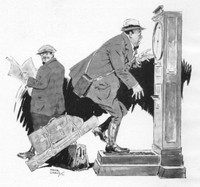
John Henry's narration is the collection's unifying device. He speaks in a folksy, hyperbolic register, peppering his accounts with slang ('choo-choo,' 'boob community') and mock-heroic comparisons. The stories follow a predictable arc: an idea is hatched, complications ensue, and the narrator ends up out of pocket or embarrassed. Yet the repetition becomes a feature, not a flaw, as readers anticipate the next misadventure. Hobart avoids sentimentality, instead mining humor from the gap between intention and outcome. The illustrations by Edward Carey, mentioned in the front matter, likely amplify the physical comedy, though the text itself relies on verbal wit and situational irony.
Readers approaching You Should Worry Says John Henry should expect a series of loosely connected episodes rather than a novel. The humor is period-specific—tango lessons, automobiles, and dieting fads—but the dynamic of a well-meaning narrator outfoxed by his own schemes remains timeless. Pay attention to the recurring characters and the narrator's distinctive voice, which gives the collection its consistent charm.
There’s a particular ache in You Should Worry Says John Henry—that feeling of laughing at your own clumsy life, tango steps gone wrong, the scale’s cruel jokes. It made me think of quiet mornings instead, the way patience humbles us. I found myself drifting toward Mr. Punch with Rod and Gun: The Humours of Fishing and Shooting — Edition Insights, those gentler absurdities of waiting and missing. Both feel like old friends, winking across the years.
Create a short personal record of your experience with this book.