About 67 minutes
Mr. Punch's After-Dinner Stories — Text and Context
Adventure Picaresque Fiction
15,183 recorded words. 2 minutes difference from this book's estimate.
View Gutenberg source #33824
Mr. Punch with Rod and Gun: The Humours of Fishing and Shooting — Edition Insights can be approached with a clearer sense of reading commitment from its source measurements: 15,745 words, 1 hr 9 min estimated reading time, and 5 detected text sections.
The text analysis averages about 13.5 words per sentence, while the detected sections provide another way to judge how the source is divided.
Project Gutenberg metadata also associates the work with “English wit and humor,” connecting these edition facts with the source record’s subject description.
Explore this collection
These alternatives are selected using recorded categories and estimated reading time.
About 67 minutes
Adventure Picaresque Fiction
15,183 recorded words. 2 minutes difference from this book's estimate.
View Gutenberg source #33824About 73 minutes
Adventure Picaresque Fiction
16,752 recorded words. 4 minutes difference from this book's estimate.
View Gutenberg source #52365About 84 minutes
Adventure Picaresque Fiction
19,168 recorded words. 15 minutes difference from this book's estimate.
View Gutenberg source #38146Search stored excerpts and compare books → Choose by your preferences →
Choices use stored catalog measurements. Estimates vary with reading speed. A shared category is a catalog label, not a claim that two books have the same argument or literary quality.
Search reads excerpt text stored with this catalog and links to its associated Gutenberg record. The connection is stored in the site database; this tool does not recheck that every excerpt is word-for-word identical to that external record. Excerpt search does not cover every chapter and does not verify historical publication dates.
Catalog snapshot checked: 2026-09-25. Coverage: 91 public books, 91 available source excerpts.
Read the complete public-domain text at its original source.
Read on Project GutenbergThe volume opens with a preface that sets the tone: Mr. Punch treats fishermen and hunters with genial mockery, targeting their exaggerations, impatience, and the ridicule they face from onlookers. The first cartoon, 'A Feat of Agility,' shows a man in a punt struggling with a pole while his companion yells, 'Now then, you idiot, keep still! I've got a nibble!'—a scene that immediately establishes the book's focus on mishaps and verbal comedy.
Editor J. A. Hammerton frames the collection as part of the 'Punch Library of Humour,' a series designed to present the cream of national humor. The excerpts reveal a structure built around short captions, one-liners, and list-based jokes, such as 'The Anatomy of Shooting,' which enumerates the many excuses bad shots make. This is not a narrative but a curated gallery of comic moments.
The fishing humor relies heavily on the contrast between the angler's self-image and reality. In one cartoon, a fisherman announces he has a nibble while his companion is about to fall into the water. Another joke targets the habit of exaggerating catches: the preface notes that Mr. Punch is especially keen on 'the angler's habit of exaggerating the size of his catch.' The excerpts do not include a full narrative, but the pattern is clear—the fisherman is often the butt of the joke, whether through his own impatience or the commentary of bystanders.
Several gags hinge on the fisherman's thirst, a recurring motif. The preface mentions 'the proverbial thirst that attacks the fisherman, whether he catches anything or not,' and the cartoons likely illustrate this. The humor is gentle but pointed, inviting readers to laugh at themselves.
The shooting section is dominated by list-based humor. 'The Anatomy of Shooting' enumerates 15 types of men 'we never meet,' including the man who makes no excuses for shooting badly, the man whose dog hasn't a good nose, and the man who hasn't made a longer shot than anyone in the company. This list is a satirical taxonomy of the sporting ego.
Other jokes target the bad shot who hits dogs or companions, as in the preface's reference to 'the man who can't hit the birds, or is always hitting the dogs or his companion guns.' A cartoon shows a sportsman who has just knocked over a buck and asks for the head to mount, only to be told it would 'ruin the sale of the carcase.' The humor is economical, often delivered in a single line of dialogue.
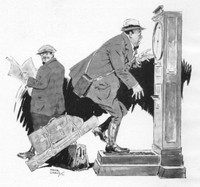
The book boasts 193 illustrations by a roster of celebrated Punch artists, including Charles Keene, John Leech, Phil May, and George Du Maurier. The excerpts do not reproduce the images, but the captions hint at their content. For instance, 'A Feat of Agility' likely shows a physical comedy scene, while 'Damaged Goods' depicts a tense exchange between a sportsman and a landowner.
The preface highlights that 'most of the best-known Punch artists, old and new, have revelled in the humours of both fishing and shooting.' The variety of artists suggests a range of styles, from Keene's detailed line work to Phil May's economical sketches. Readers should pay attention to how the illustrations amplify the jokes, often through facial expressions and body language.
The book is part of the 'Punch Library of Humour,' a 25-volume series covering topics from 'Life in London' to 'Golf Stories.' This volume is organized thematically around fishing and shooting, but the excerpts show no overarching plot or character development. Instead, the humor is episodic, with each cartoon or joke standing alone.
The preface frames the collection as a jovial look at the weaknesses of sportsmen, and the excerpts confirm this. The jokes are often situational, relying on a single punchline. For example, 'A Blank Day' features two friends: one says 'The birds are terribly wild to-day,' and the other replies, 'Not half so wild as our host will be, if it keeps on like this.' The humor is immediate and requires no context.
Approach this book as a browsing volume rather than a linear read. The humor is best appreciated in small doses, allowing each cartoon and caption to land. Pay attention to the interplay between text and image, as the illustrations often carry the joke. The collection offers a window into Victorian and Edwardian sporting culture, where self-deprecation and camaraderie were central to the humor.
I’ve often thought the men who laughed in these angling pages, with their grand fibs and damp mishaps, were the very souls who later gathered by the fire, telling tales without a rod in sight. Their humor carries a certain staying warmth, much like the company found in Mr. Punch's After-Dinner Stories — Text and Context, where wit lingers softly after the last course is cleared.
Use these questions to collect your thoughts before moving on.