About 85 minutes
Mr. Punch's Book of Love: Being the Humours of Courtship and Matrimony — A Reader’s Guide
Adventure Picaresque Fiction
19,524 recorded words. 1 minutes difference from this book's estimate.
View Gutenberg source #42400
This digital edition of Mr. Punch on the Warpath: Humours of the Army, the Navy and the Reserve Forces — Reading Companion is described by source-level measurements including 19,168 words, 1 hr 24 min estimated reading time, and 5 detected text sections.
The text analysis averages about 13.7 words per sentence, while the detected sections provide another way to judge how the source is divided.
Project Gutenberg metadata also associates the work with “English wit and humor,” connecting these edition facts with the source record’s subject description.
Explore this collection
These alternatives are selected using recorded categories and estimated reading time.
About 85 minutes
Adventure Picaresque Fiction
19,524 recorded words. 1 minutes difference from this book's estimate.
View Gutenberg source #42400About 91 minutes
Adventure Picaresque Fiction
20,708 recorded words. 7 minutes difference from this book's estimate.
View Gutenberg source #16197About 73 minutes
Adventure Picaresque Fiction
16,752 recorded words. 11 minutes difference from this book's estimate.
View Gutenberg source #52365Search stored excerpts and compare books → Choose by your preferences →
Choices use stored catalog measurements. Estimates vary with reading speed. A shared category is a catalog label, not a claim that two books have the same argument or literary quality.
Search reads excerpt text stored with this catalog and links to its associated Gutenberg record. The connection is stored in the site database; this tool does not recheck that every excerpt is word-for-word identical to that external record. Excerpt search does not cover every chapter and does not verify historical publication dates.
Catalog snapshot checked: 2026-09-25. Coverage: 91 public books, 91 available source excerpts.
Read the complete public-domain text at its original source.
Read on Project GutenbergThis volume collects military humour from Punch magazine, spanning the mid-19th century to the early 20th. The editor, J. A. Hammerton, frames the collection as a record of "mimic battle" rather than real war, noting that recent conflict left the magazine "too sore of heart to say much about it." The humour relies on absurdist dialogue and bureaucratic parody: a general defines cavalry's use as giving "tone to what would otherwise be a mere vulgar brawl," while a doctor tells a soldier who slept "as sound as a dog" to "see the vet."
The excerpts repeatedly mock military hierarchy through clipped, deadpan exchanges. A general's lofty definition of cavalry's purpose reduces warfare to etiquette. A naval officer's riddle—"why am I like the Queen's chief cook?"—earns the reply "Because I am in a high cool-and-airy (culinary) position," prompting Punch to scold the cadet for joking "up in the air." These dialogues rely on the tension between formal rank and trivial content. The humour often hinges on a subordinate's literal-mindedness or a superior's obliviousness, as when a lubber's attempt at a witticism about grey paint fails because his mate intended the same joke. The effect is a world where communication is perpetually misfired, and authority is undercut by its own pomposity.
The "Regulations for Yeomanry Outposts (Aldershot Edition)" is a standout piece of sustained parody. Eleven numbered rules invert military logic: "Never recognise your enemy when you meet him on the road, in case you might be compelled to take him prisoner and so cause unpleasantness." The rules advocate surrendering "without noise or alarm," attacking only in front (as flank attacks are "unsportsmanlike"), and retiring directly onto friendly infantry to be shot at by both sides. The motto "Point de Zèle" (no zeal) crowns the satire. This section demonstrates how Punch weaponised the dry, instructional tone of official manuals to expose the absurdity of peacetime soldiering, where rolling cloaks and burnishing bits matter more than tactics.
The 1859 "Peace Song" by Mr. Punch offers a different register: rhymed, rousing, and ostensibly patriotic. It advocates arming as "Rifle Volunteers" to guard against invasion, with stanzas dismissing alarmists and claiming that increasing forces shows "no wish for fighting." Yet the refrain's jingoistic cheer is undercut by the context of the collection—surrounded by cartoons of bumbling volunteers and incompetent officers. The song's earnestness feels like another layer of satire, especially when it warns that "the Eagles / May draw our dove's nest near." The juxtaposition of martial verse with the preceding absurd regulations suggests that Punch saw volunteering as both a necessary precaution and a rich source of comedy.
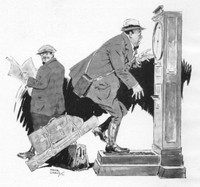
The title page lists 136 illustrations by artists including Reginald Cleaver, Tom Browne, Charles Keene, and Phil May. While the excerpts provide only text, the visual component is integral: the book is part of the "Punch Library of Humour" series, each volume fully illustrated. The editor notes that Charles Keene "found many of his happiest subjects in the humours of military life and volunteering." The cartoons likely amplify the verbal jokes—for instance, the image of a cadet nearly falling from a yard while joking, or an "economical mode of putting troops into white trowsers." Readers should imagine the interplay of word and image, where a single drawing can transform a mild quip into a scene of physical comedy.
This collection preserves a specific strain of British humour: self-deprecating, institutionally sceptical, and fond of absurd logic. Readers will find no bloodshed, only the comedy of preparation—marching drills, misunderstood orders, and the eternal gap between regulation and reality. The book rewards attention to tone, as the same authorial voice can shift from dry regulation parody to patriotic verse. It is best enjoyed as a period piece, a window into how a nation that saw itself as "a warlike people" chose to laugh at its own armed forces.
There’s something tender about those old Punch jokes, ten thousand tiny formalities collapsing under their own weight. I keep thinking how the same bureaucratic absurdity haunts the pages of One Third Off — Text and Context, only closer to home, quieter. That book feels like a letter left half-written on a mailroom desk, never sent. We just smile, nod, and file it away.
Capture what you thought, learned, and would like to remember.