About 69 minutes
Mr. Punch with Rod and Gun: The Humours of Fishing and Shooting — Edition Insights
Adventure Picaresque Fiction
15,745 recorded words. 4 minutes difference from this book's estimate.
View Gutenberg source #45748
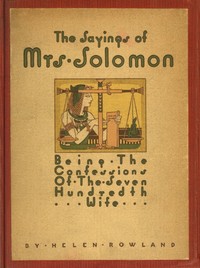
For The Sayings of Mrs. Solomon being the confessions of the seven hundredth wife as revealed to Helen Rowland — Story, Setting & Ideas, the stored edition analysis reports 16,752 words, 1 hr 13 min estimated reading time, and 10 detected text sections.
The text analysis averages about 17.6 words per sentence, while the detected sections provide another way to judge how the source is divided.
Project Gutenberg metadata also associates the work with “American wit and humor,” connecting these edition facts with the source record’s subject description.
Explore this collection
These alternatives are selected using recorded categories and estimated reading time.
About 69 minutes
Adventure Picaresque Fiction
15,745 recorded words. 4 minutes difference from this book's estimate.
View Gutenberg source #45748About 67 minutes
Adventure Picaresque Fiction
15,183 recorded words. 6 minutes difference from this book's estimate.
View Gutenberg source #33824About 84 minutes
Adventure Picaresque Fiction
19,168 recorded words. 11 minutes difference from this book's estimate.
View Gutenberg source #38146Search stored excerpts and compare books → Choose by your preferences →
Choices use stored catalog measurements. Estimates vary with reading speed. A shared category is a catalog label, not a claim that two books have the same argument or literary quality.
Search reads excerpt text stored with this catalog and links to its associated Gutenberg record. The connection is stored in the site database; this tool does not recheck that every excerpt is word-for-word identical to that external record. Excerpt search does not cover every chapter and does not verify historical publication dates.
Catalog snapshot checked: 2026-09-25. Coverage: 91 public books, 91 available source excerpts.
Read the complete public-domain text at its original source.
Read on Project GutenbergThe voice of Mrs. Solomon arrives fully formed in the opening “Greeting,” speaking in a mock-biblical register that never wavers. “Hearken, my Daughter, and give ear unto my wisdom,” she begins, and the archaic syntax immediately establishes her as a parodic sage—one who claims to have learned of men by knowing “but one man well.” This framing device, sustained across eight books, allows Rowland to deliver a series of epigrammatic observations that oscillate between apparent endorsement and sly subversion. The narrator’s authority is both asserted and undercut: she is the seven-hundredth wife, an expert by sheer accumulation, yet her confessions are “as revealed to” Rowland, a real author of bachelor-girl reflections. The resulting tension between biblical gravity and modern cynicism drives the book’s comic engine.
The most striking feature of The Sayings of Mrs. Solomon is its sustained imitation of the King James Bible. Rowland peppers the text with “Verily,” “Lo,” “Yea,” and “Selah,” and structures chapters as pseudo-proverbs. Yet the content is thoroughly modern and irreverent. For instance, the “Book of Husbands” opens by declaring a husband a “Good Thing” that “giveth the house a ‘finished’ look, even as a rubber plant and a door-plate.” The simile deflates the biblical solemnity: a husband is reduced to decor. This technique recurs throughout: the lofty form is used to deliver worldly, often cynical, observations about marriage, flirtation, and domestic life. The effect is a kind of ironic ventriloquism—Mrs. Solomon sounds like a prophet but thinks like a gossip. The reader is never allowed to forget the gap between the archaic language and the modern, urban sensibility it conveys.
Rowland controls pace by alternating between short, punchy aphorisms and slightly longer illustrative passages. The aphorisms often land as one-liners: “For men are of but one pattern, whereof thou needest but to discover the secret combination; but women are as the Yale lock—no two of them are alike.” These appear in clusters, creating a staccato rhythm that mimics the rapid-fire delivery of a stand-up comic. In contrast, the “Book of Sirens” slows down to develop a sustained warning about Trained Nurses, complete with a mini-narrative: “When he is down-and-out she getteth in her fine work.” The shift from general maxim to specific scenario gives the reader a breather and adds texture. The “Book of Songs” (not excerpted) likely continues this pattern. The overall effect is a book that can be dipped into or read straight through, with the epigrams functioning as punchlines and the longer passages as comic sketches.
Certain motifs recur across the books, creating a cohesive worldview. One is the catalog of domestic objects used to measure a husband’s value: he is like a “rubber plant,” a “door-plate,” a “potted palm,” a “centerpiece.” These comparisons are deliberately reductive, suggesting that marriage is a matter of social display rather than emotional depth. Another motif is the inversion of biblical wisdom: where Proverbs praises the virtuous woman, Mrs. Solomon praises the widow who “hath graduated from the School of Experience” and can “make a man comfortable—which is the secret of all wisdom.” The widow is the true sage, not the virgin. The “Book of Sirens” introduces the Trained Nurse as a new type of femme fatale, more dangerous than Circe because she operates in the domestic sphere. These recurring figures—the husband as ornament, the widow as expert, the nurse as siren—give the book a thematic coherence beneath its episodic surface.
Readers will find that the book rewards attention to its verbal play and structural ironies. The mock-biblical frame is not a gimmick but a lens through which Rowland examines early twentieth-century gender roles with precision. Because the excerpts are incomplete, the full arc of Mrs. Solomon’s “confessions” remains uncertain, but the voice is consistent enough to sustain interest. Approach it as a performance of ironic wisdom, and let the epigrams accumulate.
I think of Mrs. Solomon whispering her married wisdom in 1913—that wry, biblical calm over chaos—and somehow it always reminds me of John Henry’s answering chuckle. They share a kind of sideways patience, two voices refusing to take the world too solemnly. Their kinship isn’t argument, just a nod across decades. You Should Worry Says John Henry — Themes and Context sits beside her on my shelf like an old friend who finishes your sentences.
A brief reflection can help important ideas stay with you longer.