About 232 minutes
German wit and humor — A Reader’s Guide
Adventure Picaresque Fiction
53,156 recorded words. 3 minutes difference from this book's estimate.
View Gutenberg source #74708
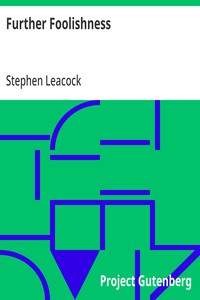
The source record for Further Foolishness — Themes and Context measures this digital text at 52,616 words, 3 hr 49 min estimated reading time, and 6 detected text sections.
The text analysis averages about 13.0 words per sentence, while the detected sections provide another way to judge how the source is divided.
Project Gutenberg metadata also associates the work with “Canadian wit and humor,” connecting these edition facts with the source record’s subject description.
Explore this collection
These alternatives are selected using recorded categories and estimated reading time.
About 232 minutes
Adventure Picaresque Fiction
53,156 recorded words. 3 minutes difference from this book's estimate.
View Gutenberg source #74708About 206 minutes
Adventure Picaresque Fiction
47,310 recorded words. 23 minutes difference from this book's estimate.
View Gutenberg source #21196About 195 minutes
Adventure Picaresque Fiction
44,839 recorded words. 34 minutes difference from this book's estimate.
View Gutenberg source #74088Search stored excerpts and compare books → Choose by your preferences →
Choices use stored catalog measurements. Estimates vary with reading speed. A shared category is a catalog label, not a claim that two books have the same argument or literary quality.
Search reads excerpt text stored with this catalog and links to its associated Gutenberg record. The connection is stored in the site database; this tool does not recheck that every excerpt is word-for-word identical to that external record. Excerpt search does not cover every chapter and does not verify historical publication dates.
Catalog snapshot checked: 2026-09-25. Coverage: 91 public books, 91 available source excerpts.
Read the complete public-domain text at its original source.
Read on Project GutenbergStephen Leacock’s 1916 collection opens with a preface that doubles as a mission statement: an old schoolmaster’s cry of “any further foolishness?” becomes the author’s cue to oblige his indulgent readers. The first sketch, “Stories Shorter Still,” takes aim at the craze for brevity in fiction. Leacock offers an “Irreducible Detective Story” that compresses the entire mystery into a single hair—literally. The detective picks a hair off the corpse, finds a man with a steamer cap, and declares the case solved. The joke lands on the absurdity of reduction: a whole genre boiled down to one clue, one suspect, one arrest.
Leacock’s satire works by pushing a single premise to its logical extreme. In the detective story, the chain of reasoning is “inexorable” precisely because it is ridiculous: the detective scans New York for a man who lost a hair, finds him disguised as a tourist, and brandishes the hair aloft. The parody depends on the reader recognizing the conventions of the genre—the great detective, the microscopic clue, the dramatic unmasking—and watching them collapse under their own weight. Leacock does not need to invent new rules; he simply follows the old ones too far.
The same technique appears in the German travel sketch. Count von Boobenstein explains the army’s size with a cascade of arithmetic: three million, plus reserves, plus volunteers, minus casualties, plus returns, multiplied by fronts, yielding thirty-six million. The numbers are plausible enough to sound official, but the accumulation becomes absurd. Leacock’s deadpan delivery—the narrator nods and says “I see”—heightens the effect. The reader is left to decide whether the satire targets German militarism, statistical propaganda, or both.
In the Berlin restaurant scene, Leacock replaces food with documents. The waiter brings “ham certificate with a cabbage ticket,” “lobster-coupon with a receipt for asparagus,” and “beef certificates with an affidavit for Yorkshire pudding.” The diners chew the corners of their coupons while sipping beer. The substitution is literal: the paper becomes the meal. This is satire by material metaphor, turning a wartime scarcity into a bureaucratic farce.
Leacock’s narrator plays the straight man, asking for a “beef certificate” because the journey has made him hungry. The humor depends on the gap between the expected (a real meal) and the delivered (a slip of paper). The Count’s boast that Germany has “overcome the food difficulty for ever” rings hollow when the only thing on the table is colored tickets. The sketch does not need to state the grim reality; the absurdity of the scene implies it.
Throughout the excerpts, Leacock’s narrator maintains a tone of polite bewilderment. He asks questions, accepts explanations, and records what he sees without overt judgment. When Count von Boobenstein describes the Landslide—the final levy of brewery workers—the narrator does not laugh. He simply reports. This persona is essential to the satire: the narrator’s credulity makes the absurdity stand out more sharply.
The same voice appears in the detective story, where the narrator recounts events with the flatness of a police report: “The mystery had now reached its climax.” The contrast between the dramatic language and the trivial clue (a single hair) creates the comedy. Leacock’s skill lies in maintaining this deadpan register even as the situations grow more outlandish. The reader is never winked at; the joke is allowed to speak for itself.
The table of contents reveals a book that parodies not only content but form. Leacock includes chapters with Roman numerals that skip numbers (III, IV, V, X, XI, XIII, XIV, XV, XVI, XVII) and headings that mimic academic or journalistic categories: “A Study in Still Life—My Tailor,” “Germany from Within Out,” “The White House from Without In.” The symmetry of “from Within Out” and “from Without In” signals a playful inversion of the travelogue and political analysis genres.
Inside the sketches, structure itself becomes a target. The detective story is titled “An Irreducible Detective Story” and subtitled “Hanged by a Hair or A Murder Mystery Minimised.” The subtitle promises a miniature, and the story delivers: the entire plot unfolds in a few paragraphs. Leacock is not just writing a parody; he is demonstrating that the genre can be reduced to its bare bones without losing its essential absurdity.
Leacock’s collection rewards readers who pay attention to the mechanics of his jokes. The humor often depends on recognizing the conventions he is twisting—the detective story, the war correspondent’s dispatch, the statistical report. The preface warns that the book is meant to be “further foolishness,” but the foolishness is carefully constructed. A first reading benefits from noticing how Leacock sets up his targets: the straight man narrator, the literal-minded logic, the substitution of paper for substance. These are the tools that turn a sketch into satire.
There’s a particular comfort in the way Leacock’s wartime sketches find humor without ever forcing it—those civilians chewing their food tickets still make me smile years later. It reminds me of that other quiet companion on my shelf, Burgess Unabridged: A new dictionary of words you have always needed — Reading Companion, which always seems to know the exact word for a feeling I’d misplaced. Funny how old friends do that.
A brief reflection can help important ideas stay with you longer.