About 112 minutes
The Slim Princess — Story, Setting & Ideas
Adventure Picaresque Fiction
25,550 recorded words. 22 minutes difference from this book's estimate.
View Gutenberg source #11279
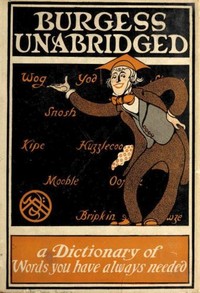
This digital edition of Burgess Unabridged: A new dictionary of words you have always needed — Reading Companion is described by source-level measurements including 30,699 words, 2 hr 14 min estimated reading time, and 6 detected text sections.
The text analysis averages about 13.6 words per sentence, while the detected sections provide another way to judge how the source is divided.
Project Gutenberg metadata also associates the work with “American wit and humor,” connecting these edition facts with the source record’s subject description.
Explore this collection
These alternatives are selected using recorded categories and estimated reading time.
About 112 minutes
Adventure Picaresque Fiction
25,550 recorded words. 22 minutes difference from this book's estimate.
View Gutenberg source #11279About 109 minutes
Adventure Picaresque Fiction
24,920 recorded words. 25 minutes difference from this book's estimate.
View Gutenberg source #984About 96 minutes
Adventure Picaresque Fiction
21,869 recorded words. 38 minutes difference from this book's estimate.
View Gutenberg source #20584Search stored excerpts and compare books → Choose by your preferences →
Choices use stored catalog measurements. Estimates vary with reading speed. A shared category is a catalog label, not a claim that two books have the same argument or literary quality.
Search reads excerpt text stored with this catalog and links to its associated Gutenberg record. The connection is stored in the site database; this tool does not recheck that every excerpt is word-for-word identical to that external record. Excerpt search does not cover every chapter and does not verify historical publication dates.
Catalog snapshot checked: 2026-09-25. Coverage: 91 public books, 91 available source excerpts.
Read the complete public-domain text at its original source.
Read on Project GutenbergGelett Burgess, best known for coining "bromide" and "sulphite," here expands his lexical invention into a full dictionary of made-up words for the year 1915. The book's preface declares English a "growing language" that "snuggles right down where you live," setting a playful, anti-academic tone. Each entry pairs a faux-formal definition with a rhyming quatrain and cross-references to other invented terms, creating a self-referential system of humor. Herb Roth's illustrations, listed in a frontispiece index, complement the verbal wit with visual gags.
Burgess adopts the solemn cadence of a real dictionary while undercutting it with absurdity. The definition of Meem, for instance, begins with clinical precision—"An artificial half light that women love; a charitable obscurity"—then slides into a poem that winks at the reader: "All meemy was the studio, / And meemy maidens—wait! / Say, were they maidens? Heavens, no! / Are maidens thirty-eight?" The shift from declarative prose to verse is abrupt, mimicking the way a standard dictionary might quote usage, but here the "usage" is Burgess's own comic invention. The cross-references (e.g., See Kipe) further parody scholarly apparatus, creating a mock-serious network that rewards browsing.
The entries vary in length and rhythm. Some, like Mooble, run long, accumulating examples: "Dancing with your own wife is a mooble—a fairly good play, a dinner-party where the ménu makes up for the dramatis personæ—moobles!" The list accelerates, piling up targets (tall blonde women, the W.C.T.U., commencement essays) before landing on a punchline: "the perfect mooble is the man you used to be engaged to." Others, like Moosoo, are tighter, defining a mood with a few concrete scenarios. This alternation between expansive cataloging and concise snapshots controls the reading pace, inviting both quick dips and longer stays.
Several structural tics recur across entries. Nearly every definition includes a parenthetical cross-reference, often to a term not yet encountered, encouraging nonlinear reading. Many entries end with a four-line poem that restates the definition in rhyme, creating a predictable but satisfying closure. Burgess also repeats certain rhetorical moves: the use of "the" plus a generic noun ("the meemy woman," "the tame young man") to typify social types, and the habit of listing mundane examples ("cornstarch custard, warm iced tea, vanilla ice cream") to ground abstract concepts. These patterns give the dictionary a coherent voice even as the subjects range from vanity to ineptitude.
Because the entries are self-contained, readers can start anywhere—but the cross-references reward sequential browsing. Pay attention to the poems: they often sharpen the satire that the prose softens. The book's humor depends on recognizing the social types Burgess skewers, so reading with an eye for early-20th-century manners adds another layer. Treat the dictionary not as a reference but as a continuous comic performance, where the joke is as much in the form as in the content.
I keep thinking about Burgess's made-up words — how each one holds a little mirror to how we behave. Then I stumbled onto that old collection of seventeenth-century jokes and jabs, Humour, Wit, & Satire of the Seventeenth Century — Reading Notes, and it felt familiar, like laughter across centuries, quietly pointing out the same human silliness.
A brief reflection can help important ideas stay with you longer.