1

Mr. Punch's Book of Love: Being the Humours of Courtship and Matrimony — A Reader’s Guide
(0 User reviews)
338
Project Gutenberg
2013
Not confirmed
English wit and humor; English wit and humor, Pictorial; Marriage -- Humor; Man-woman relationships -- Humor; Love -- Humor
Readers of public-domain and historical texts
Project Gutenberg digital edition
en
Edition facts
Words
19,524
Reading time
85 min
Text sections
5
For Mr. Punch's Book of Love: Being the Humours of Courtship and Matrimony — A Reader’s Guide, the stored edition analysis reports 19,524 words, 1 hr 25 min estimated reading time, and 5 detected text sections.
The text analysis averages about 12.6 words per sentence, while the detected sections provide another way to judge how the source is divided.
Project Gutenberg metadata also associates the work with “English wit and humor,” connecting these edition facts with the source record’s subject description.
Source:
Project Gutenberg record #42400
A Victorian-era anthology of Punch magazine's best jokes, cartoons, and verse on courtship and marriage, featuring 150 illustrations by John Leech, Charles Keene, and others, with a satirical preface debunking the origin of Punch's famous 'Don't!' advice.
Read the complete public-domain text at its original source.
Read on Project GutenbergThe volume opens with a preface that immediately sets a skeptical tone, debunking the myth that Mark Twain wrote Punch's famous line, 'Advice to persons about to marry,—Don't!' The editor, J. A. Hammerton, credits Henry Mayhew with the quip, using this anecdote to signal that the collection prizes wit over sentiment. The first page of content then plunges into a rapid-fire exchange: Edwin and Angelina's staccato 'Darling!' repetition, which a 'Bilious Old Gentleman' finds sickening. This pairing of editorial commentary and comic vignette establishes the book's method—juxtaposing knowing asides with the humour itself.
The Anatomy of a Punch Joke
The excerpts reveal a consistent structure: a short setup, often a single line of dialogue, followed by a deflating punchline. In 'The Seven Wonders of a Married Man,' the list form itself becomes the joke, enumerating impossible virtues like 'Not going to sleep after dinner!' The parallel 'Seven Wonders of a Married Woman' mirrors the format, ending with the wife never calling her husband 'a brute.' The humour relies on shared stereotypes—the henpecked husband, the nagging wife—but the symmetrical lists also invite readers to compare the double standards. A one-liner like 'All for Money' renames the honeymoon the 'moneymoon,' compressing a whole social critique into a single word. These jokes work best when read aloud, their rhythm depending on the pause before the punch.
Courtship as Combat
Many entries treat romantic pursuit as a battle of wits or a transaction. In 'Quod Erat Demonstrandum,' a friend congratulates a rejected suitor on his 'brains'—implying he has none. The dialogue form lets the insult land without narrator commentary. Elsewhere, a housemaid on Valentine's Day receives more cards than her mistress, upending class expectations. The poem 'Waiting' shifts tone, addressing an 'Enchantress with the nut-brown hair' who works at an A.B.C. tea shop, blending romantic longing with mundane details like 'tea and toast.' This mix of the ideal and the everyday is typical: love is both a lofty pursuit and a source of practical jokes. The book rarely lets a sentimental moment stand without a deflating remark nearby.
Marriage as a Set of Rules
The excerpts repeatedly frame marriage as a system of unwritten rules that are constantly broken. 'The Balance Restored' shows a wife claiming she married out of pity, and the husband retorting that now everyone pities him—a symmetrical reversal. The 'Seven Wonders' lists imply that the ideal spouse is a fiction; the real work of marriage is managing disappointment. A joke about a man who marries his cook blurs class and domestic roles, while 'As Man's Ingratitude' has a husband admit he was 'well off' before marriage but 'didn't know it'—a pun on financial and emotional wealth. These pieces assume a knowing audience familiar with the tensions of Victorian domestic life, and they rarely side entirely with husband or wife.
The Role of the Illustrations
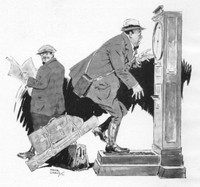
Though the text can stand alone, the 150 illustrations by artists like John Leech and George Du Maurier are integral to the humour. The excerpts include no images, but the captions often depend on visual cues: a 'Gilded Youth' looking foolish, a 'Comely Housemaid' smirking. The preface mentions Harry Furniss's drawing of a tramp with a soap testimonial, showing how image and text combine for effect. Readers should imagine the cartoons as they read—the exaggerated expressions, the period costumes. The book was designed as a physical object, part of the 'Punch Library of Humour' series, meant for browsing. The illustrations break up the text and add a layer of satire that the words alone cannot convey.
This collection rewards dipping in at any point, but reading the preface first clarifies the editor's dry, debunking stance. The jokes are best taken in small doses; their cumulative effect can feel repetitive. Pay attention to the dates: though undated in the excerpts, the styles range from early Victorian to Edwardian, and the humour shifts accordingly. The book is a time capsule of what amused the British middle class about love—and what they preferred to laugh at rather than examine too closely.
I’ve often smiled at the old Punch anthology, its gentle mockery of hearts entangled, wondering how many couples laughed together over those very pages. That same warm, knowing mischief breathes in Further Foolishness — not a sequel, exactly, but a kindred shelf companion. Further Foolishness — Themes and Context holds the quiet echo of those Victorian sighs.
There are no reviews for this eBook.
There are no comments for this eBook.
Reader reflection
Take a moment to reflect on this book
Create a short personal record of your experience with this book.
Your progress
0
/
10
2
Was reading this book enjoyable?
3
Is this a title you would suggest to others?
4
How easy was the book to follow?
5
How much did the book move you?
6
Did the book deliver what you hoped for?
7
How personally connected did you feel to the book?
8
How useful were the ideas in this book?
9
In one sentence, what did you learn?
10