About 559 minutes
Humour, Wit, & Satire of the Seventeenth Century — Reading Notes
Adventure Picaresque Fiction
128,422 recorded words. 105 minutes difference from this book's estimate.
View Gutenberg source #50874
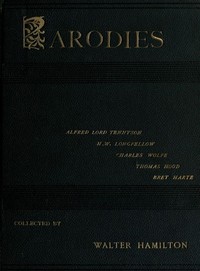
Before opening Parodies of the works of English & American authors, vol. I — Inside the Classic, the edition data offers a quick orientation: 152,539 words, 11 hr 4 min estimated reading time, and 31 detected text sections.
The text analysis averages about 20.2 words per sentence, while the detected sections provide another way to judge how the source is divided.
Project Gutenberg metadata also associates the work with “Parodies,” connecting these edition facts with the source record’s subject description.
Explore this collection
These alternatives are selected using recorded categories and estimated reading time.
About 559 minutes
Adventure Picaresque Fiction
128,422 recorded words. 105 minutes difference from this book's estimate.
View Gutenberg source #50874About 506 minutes
Adventure Picaresque Fiction
116,328 recorded words. 158 minutes difference from this book's estimate.
View Gutenberg source #20352About 352 minutes
Adventure Picaresque Fiction
80,836 recorded words. 312 minutes difference from this book's estimate.
View Gutenberg source #32960Search stored excerpts and compare books → Choose by your preferences →
Choices use stored catalog measurements. Estimates vary with reading speed. A shared category is a catalog label, not a claim that two books have the same argument or literary quality.
Search reads excerpt text stored with this catalog and links to its associated Gutenberg record. The connection is stored in the site database; this tool does not recheck that every excerpt is word-for-word identical to that external record. Excerpt search does not cover every chapter and does not verify historical publication dates.
Catalog snapshot checked: 2026-09-25. Coverage: 91 public books, 91 available source excerpts.
Read the complete public-domain text at its original source.
Read on Project GutenbergWalter Hamilton's 1884 compilation presents parodies of five poets—Alfred, Lord Tennyson, Henry Wadsworth Longfellow, Bret Harte, Thomas Hood, and the Reverend C. Wolfe—gathered from various sources and annotated by the editor. The volume opens with a preface explaining that the project began as a modest selection but expanded due to popular demand and subscriber contributions of rare books and copies. Hamilton includes a French epigraph from Abbé Sallier (1733) arguing that parody must target well-known, esteemed works and that humor should arise naturally from the subject. The collection's structure reflects this principle, organizing parodies by original poem rather than by author of the parody.
Hamilton's preface reveals a deliberate editorial process: he altered the original plan to avoid monotony—for instance, spreading parodies of a single short poem like 'Excelsior' across multiple issues. He credits subscribers for loans of scarce books and copies, which made the collection more complete. The index, carefully compiled, cross-references parodies under the titles of original poems. This methodical approach suggests Hamilton aimed for scholarly utility rather than mere entertainment. The volume's front matter also includes a defense of parody from Isaac D'Israeli's Curiosities of Literature, framing parody as a critical tool that targets 'chimerical and false' elements in writing.
One excerpt features a parody of Longfellow's 'Song of Hiawatha' titled 'Piamater' by 'Alfred Longcove,' written for Edinburgh University's Tercentenary. The parody replaces Hiawatha's natural imagery with academic and local references: 'the scented smoke of segars,' 'the odours of the class-rooms,' and 'Bass's bittery beer.' It name-checks Edinburgh landmarks—'the Tron Kirk tower,' 'the Loch—great Duddingston,' 'the station of Haymarket'—and satirizes student life, including 'Webster's Unabridged and Walker's / Poet's Rhyming Dictionary.' Hamilton notes that some allusions are 'only of local interest,' indicating the parody's original audience was the university community.
Hamilton's preface and the D'Israeli epigraph both emphasize that parody depends on public familiarity with the original. D'Israeli writes, 'unless the prototype is familiar to us, a parody is nothing!' The volume's commercial success—'a hit—a palpable hit'—confirmed this principle. Hamilton also includes a French quotation arguing that parody must target 'un ouvrage connu, célèbre, estimé.' The collection thus functions as a historical record of which poems were widely known in the 1880s. The inclusion of parodies from periodicals and pamphlets, like the Tercentenary booklet, shows how parody circulated in ephemeral print, often tied to specific events.
Readers approaching this volume should note that Hamilton's annotations and headnotes provide context for each parody, often identifying the original poem and the source of the parody. The index is essential for navigating the collection, as parodies of the same original are grouped together. Because the excerpts are incomplete, the full range of parodied authors and styles is not visible here, but the volume offers a snapshot of Victorian literary taste and the social function of parody as both critique and entertainment.
There’s something touching about Hamilton gathering all those parodies, each one a fond poke at a voice the Victorians knew by heart. It made me think of how we keep old humor close, the way Little Masterpieces of American Wit and Humor, Volume I — Text and Context preserves that same gentle knowingness. Somewhere between the lines, you can almost hear the original writers laughing along. Little Masterpieces of American Wit and Humor, Volume I — Text and Context feels like that same quiet shelf, waiting for a slow afternoon.
Capture what you thought, learned, and would like to remember.