About 129 minutes
Further nonsense verse and prose — Text and Context
Historical Psychological Social Fiction
29,636 recorded words. 2 minutes difference from this book's estimate.
View Gutenberg source #77627
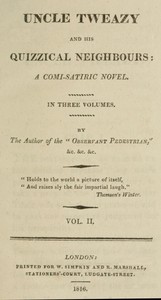
This digital edition of Uncle Tweazy and his quizzical neighbours, vol. 2 of 3 — Story, Setting & Ideas is described by source-level measurements including 29,177 words, 2 hr 7 min estimated reading time, and 16 detected text sections.
The text analysis averages about 26.1 words per sentence, while the detected sections provide another way to judge how the source is divided.
Project Gutenberg metadata also associates the work with “Satire,” connecting these edition facts with the source record’s subject description.
Explore this collection
These alternatives are selected using recorded categories and estimated reading time.
About 129 minutes
Historical Psychological Social Fiction
29,636 recorded words. 2 minutes difference from this book's estimate.
View Gutenberg source #77627About 124 minutes
Historical Psychological Social Fiction
28,466 recorded words. 3 minutes difference from this book's estimate.
View Gutenberg source #19829About 130 minutes
Historical Psychological Social Fiction
29,894 recorded words. 3 minutes difference from this book's estimate.
View Gutenberg source #77997Search stored excerpts and compare books → Choose by your preferences →
Choices use stored catalog measurements. Estimates vary with reading speed. A shared category is a catalog label, not a claim that two books have the same argument or literary quality.
Search reads excerpt text stored with this catalog and links to its associated Gutenberg record. The connection is stored in the site database; this tool does not recheck that every excerpt is word-for-word identical to that external record. Excerpt search does not cover every chapter and does not verify historical publication dates.
Catalog snapshot checked: 2026-09-25. Coverage: 91 public books, 91 available source excerpts.
Read the complete public-domain text at its original source.
Read on Project GutenbergThe second volume opens with a morning visit to the Rectory, where the narrator and his uncle are immediately struck by the beauty of Miss Fitzclarence. The description of the walk—a “delightful walk” through a shrubbery shaded by limes, leading to a low white mansion encircled by honeysuckles and roses—establishes a pastoral setting that contrasts with the satirical tone of the dialogues. The narrator’s first sight of Miss Fitzclarence, reclining on the arm of the pastor, is framed as a tableau reminiscent of Sterne’s Maria, signaling the novel’s self-conscious literary playfulness.
The narrative repeatedly emphasizes the act of looking—and not looking. The uncle “merely stolen a sidelong glance” at Miss Fitzclarence, while the narrator is compelled to “pass on the other side” to catch a better view. This choreography of glances becomes a structural motif: characters observe one another obliquely, and the reader is invited to piece together impressions from partial views. The uncle’s “eyes were rivetted on her features” only after she is seated, suggesting that full revelation is delayed. This technique mirrors the novel’s broader method of presenting characters through fragments of dialogue and gesture rather than direct exposition.
Chapter VIII pivots on a comic misunderstanding about a sermon. The uncle teases Dr. Tonic by claiming the sermon was “one of Miss Fitzclarence’s,” then clarifies he meant only that she chose it. The doctor’s eager interjection—“one of Miss Fitzclarence’s making, did you say?”—reveals his tendency to leap to conclusions. The scene is framed by a barometer reading (“mine’s up to ninety-two”), a recurring object that serves as a comic prop for the doctor’s literal-mindedness. The dialogue is punctuated by the uncle’s “key F sharp” and the doctor’s “hem—hem,” creating a rhythmic, almost musical exchange that underscores the novel’s interest in vocal mannerisms.
A brief encounter with a village girl and her dog encapsulates the novel’s moralizing strain. When the uncle strikes his stick against a paling, a “little yelping dog” named Fury rushes out, followed by Cicely, who pacifies the animal. The uncle then quizzes Cicely on the sermon text, and the narrator rewards her with a shilling. The uncle draws a lesson: “the fidelity of the dog … caused the civil interference of Cicely, who by demonstrating the truth … was rewarded.” This miniature episode—complete with a named dog, a curtseying child, and a homily—exemplifies how the novel embeds moral instruction within everyday incidents, using repetition and symmetry to drive home its points.
The narrator notes that during dinner, the uncle “never to enlarge on family topics … before servants, whom he always styled ‘telegraphs of mischief.’” This remark reveals a concern with information flow and social performance. The servants—Alice and Geoffry—are not mere background figures; Alice’s aside about Miss Fitzclarence (“a heavenly-looking young lady”) and her comic confession of inattention during the sermon show that the household is a microcosm of the village’s “mania of admiration.” The uncle’s rule about dinner conversation also highlights the novel’s structural use of confined settings (the dining room, the rectory garden) where talk is both regulated and revealing.
Readers attentive to the novel’s comi-satiric mode will find that its pleasures lie less in plot progression than in the accumulation of small, telling moments: a misheard phrase, a dog’s bark, a servant’s slip. The second volume continues to build its world through such details, inviting the reader to observe the observers and to note how admiration—whether of a person, a sermon, or a barometer—can both elevate and amuse.
I have always found a quiet kinship between Uncle Tweazy’s wary glances at village façades and the bustling, honest chaos of The True History of Tom & Jerry or, The Day and Night Scenes, of Life in London from the Start to the Finish! — A Closer Reading. Both whisper that what we parade hides more than it shows, though one laughs softly and the other with a wink.
Create a short personal record of your experience with this book.