About 302 minutes
The day's play — A Closer Reading
Fantasy Juvenile Worlds
69,255 recorded words. 2 minutes difference from this book's estimate.
View Gutenberg source #71638
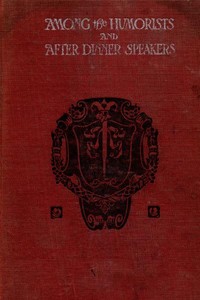
The catalog record for Among the Humorists and After Dinner Speakers, Vol. 1 A New Collection of Humorous Stories and Anecdotes — Context and Discussion provides practical reading context through 69,847 words, 5 hr 4 min estimated reading time, and 8 detected text sections.
The text analysis averages about 15.0 words per sentence, while the detected sections provide another way to judge how the source is divided.
Project Gutenberg metadata also associates the work with “Wit and humor,” connecting these edition facts with the source record’s subject description.
Explore this collection
These alternatives are selected using recorded categories and estimated reading time.
About 302 minutes
Fantasy Juvenile Worlds
69,255 recorded words. 2 minutes difference from this book's estimate.
View Gutenberg source #71638About 287 minutes
Fantasy Juvenile Worlds
65,908 recorded words. 17 minutes difference from this book's estimate.
View Gutenberg source #27917About 269 minutes
Fantasy Juvenile Worlds
61,702 recorded words. 35 minutes difference from this book's estimate.
View Gutenberg source #1999Search stored excerpts and compare books → Choose by your preferences →
Choices use stored catalog measurements. Estimates vary with reading speed. A shared category is a catalog label, not a claim that two books have the same argument or literary quality.
Search reads excerpt text stored with this catalog and links to its associated Gutenberg record. The connection is stored in the site database; this tool does not recheck that every excerpt is word-for-word identical to that external record. Excerpt search does not cover every chapter and does not verify historical publication dates.
Catalog snapshot checked: 2026-09-25. Coverage: 91 public books, 91 available source excerpts.
Read the complete public-domain text at its original source.
Read on Project GutenbergWilliam Patten's 1909 collection gathers hundreds of short humorous anecdotes, many attributed to well-known public figures of the era—politicians, clergy, actors, and writers. The preface frames wit as a weapon against oppression and a tool for political persuasion, citing Lord Palmerston and Abraham Lincoln as exemplars. The table of contents lists over sixty names, including Mark Twain, Bret Harte, J. M. Barrie, and King Edward VII, though the excerpts sample only a fraction of these contributors.
The catalog subjects—wit and humor, American wit and humor, anecdotes—accurately describe the content, but the collection's international scope (British prime ministers, Scottish churchgoers, Canadian statesmen) extends beyond American humor alone. The excerpts reveal a strong reliance on dialect and situational irony, with many jokes turning on misunderstandings or clerical foibles.
The volume is organized as a simple anthology: a preface, a partial list of contributors, and then the anecdotes themselves, grouped loosely by theme or speaker. The preface explains that the collection grew organically over years, without initial intent to publish. Patten notes only one comparable predecessor, Mark Lemon's “Jest Book,” implying a gap in the market for such a compilation.
The excerpts show a mix of very short quips (e.g., the Bishop's “it's worth it” regarding a bachelor tax) and longer narrative anecdotes (the golfing clergyman who says “Croton”). The stories vary in length from a single line to several paragraphs. The table of contents promises a wide range, but the excerpts do not include material from every listed name, making it impossible to verify the full breadth of representation.
Several patterns emerge from the excerpts. Clergymen are frequent subjects, often portrayed as unworldly or hypocritical: a bishop who prefers paying a bachelor tax to marrying, a minister whose lawn-mowing is joked about as “cutting your sermons short,” and a Presbyterian golfer who uses “Croton” as a euphemistic oath. Political figures appear too, as in the anecdote about Fred Landis's empty but effective phrase “that mystic mingling of star and clod.”
Dialect plays a key role: Scottish women discuss Napoleon in broad Scots (“the Scotch aye win their battles”), and a child's prayer ends with a football cheer. Many jokes rely on miscommunication or literal interpretation, such as the boy who rides on the cab's box seat despite being told to come back by cab. The humor is gentle, rarely cruel, and often depends on the reader recognizing a social type.
The catalog lists “Wit and humor; American wit and humor; Anecdotes” as primary subjects, with “short-stories” as a secondary topic. The excerpts confirm that the book is indeed a collection of humorous anecdotes, but the “American” label is only partially accurate. While many contributors are American (Mark Twain, George Ade, Bill Nye), the volume includes British figures like Lord Beaconsfield, Charles Lamb, and Dean Swift, as well as Canadian and Scottish characters. The anecdotes themselves are not exclusively American in setting or dialect.
The “short-stories” tag is misleading: the excerpts are very brief, rarely exceeding a few paragraphs, and lack the narrative development typical of short stories. They are closer to jokes or comic vignettes. The preface's claim that the joke “has embalmed some reputations, and has blasted others” suggests Patten saw these as historically significant, but the excerpts do not provide enough context to assess that claim.
Readers should approach this volume as a period piece of early twentieth-century humor, where punchlines often hinge on dialect, clerical mishaps, and political wordplay. The excerpts offer a glimpse into the social types and comic conventions of the era, but the full collection likely contains many more voices and variations. The editor's selection criteria remain implicit, and the book's value lies in its snapshot of what amused the public in 1909.
Long ago, I learned how a well-told yarn, like those gathered in Patten's old volume, loosens the tightest lips. There is a knowing wink in each. That same spirit of gentle mischief lives in Ade's Fables — Inside the Classic, where the wisdom arrives disguised as a chuckle, a quiet kinship across the decades.
Create a short personal record of your experience with this book.