About 25 minutes
Some Adventures of Mr. Surelock Keys — Text and Context
Fantasy Juvenile Worlds
5,589 recorded words. 1 minutes difference from this book's estimate.
View Gutenberg source #47368
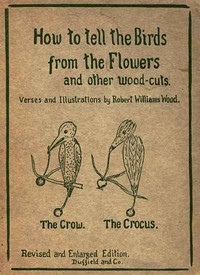
How to tell the Birds from the Flowers, and other Wood-cuts A Revised Manual of Flornithology for Beginners — Themes and Context can be approached with a clearer sense of reading commitment from its source measurements: 5,890 words, 26 min estimated reading time, and 2 detected text sections.
The text analysis averages about 26.2 words per sentence, while the detected sections provide another way to judge how the source is divided.
Project Gutenberg metadata also associates the work with “American wit and humor,” connecting these edition facts with the source record’s subject description.
Explore this collection
These alternatives are selected using recorded categories and estimated reading time.
About 25 minutes
Fantasy Juvenile Worlds
5,589 recorded words. 1 minutes difference from this book's estimate.
View Gutenberg source #47368About 20 minutes
Fantasy Juvenile Worlds
4,471 recorded words. 6 minutes difference from this book's estimate.
View Gutenberg source #1593About 20 minutes
Fantasy Juvenile Worlds
4,584 recorded words. 6 minutes difference from this book's estimate.
View Gutenberg source #43013Search stored excerpts and compare books → Choose by your preferences →
Choices use stored catalog measurements. Estimates vary with reading speed. A shared category is a catalog label, not a claim that two books have the same argument or literary quality.
Search reads excerpt text stored with this catalog and links to its associated Gutenberg record. The connection is stored in the site database; this tool does not recheck that every excerpt is word-for-word identical to that external record. Excerpt search does not cover every chapter and does not verify historical publication dates.
Catalog snapshot checked: 2026-09-25. Coverage: 91 public books, 91 available source excerpts.
Read the complete public-domain text at its original source.
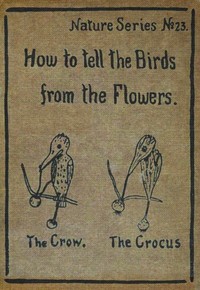
Read on Project GutenbergRobert Williams Wood's How to Tell the Birds from the Flowers (1917) is a compact cabinet of verbal and visual puns, presented as a 'Revised Manual of Flornithology for Beginners.' Each of its 49 entries pairs a bird and a plant whose names sound alike—crow and crocus, plover and clover, parrot and carrot—and supplies a short verse that teases out the confusion. Wood, a physicist known for his work in optics, brings a scientist's eye for pattern and a humorist's ear for wordplay. The woodcut illustrations are integral: they depict each pair side by side, often with deadpan literalness, so that the joke depends on the reader's willingness to see a bird's beak where a flower's petal might be. The result is a playful taxonomy that satirizes both field guides and the earnestness of nature study.
Wood's verses do not simply describe; they perform the act of misidentification. In 'The Crow. The Crocus,' he writes that 'the reason why is just be-caws / They are not versed in Nature's laws.' The pun on 'because' and 'caws' is typical: the poem enacts the confusion it purports to resolve. The meter is consistently anapestic or iambic, with a nursery-rhyme lilt that undercuts the pretense of scientific authority. For 'The Clover. The Plover,' the verse notes that 'The Plover and the Clover can be told apart with ease'—then immediately undermines that claim by offering a comically insufficient distinction. Wood's diction oscillates between Latinate botanical terms and colloquial interjections, mirroring the gap between formal classification and everyday observation.
The woodcuts are not mere illustrations; they are the primary vehicle for the joke. Each image places the bird and plant in near-identical poses, forcing the eye to compare shapes: the pelican's pouch echoes the panicle's drooping cluster; the toucan's oversized beak mirrors the pecan's nut. Wood exploits the graphic limitations of woodcut—bold outlines, flat black-and-white—to emphasize silhouette over detail. In 'The Parrot. The Carrot,' the parrot's curved beak and the carrot's tapered root are aligned vertically, so that the bird appears to be a flowering top. The effect is a visual syllogism: if a shape can belong to two categories, perhaps the categories themselves are arbitrary. The illustrations thus function as a critique of visual taxonomy, anticipating later work in perceptual psychology.
Wood's primary linguistic device is the homophone, but he also invents false etymologies to heighten the absurdity. 'The Auk. The Orchid' pairs a seabird with a flower solely on the basis of a shared initial vowel—a stretch that Wood acknowledges with a wink. In 'The Cow Bird. The Cowslip,' he suggests that the cowslip is 'a sort of mouth-piece for the Cow,' a pun that conflates botanical morphology with ventriloquism. The 'Intro-duc-tion' warns that 'some are guided by tradition, / While others use their intuition,' but Wood's own method is closer to free association. He draws on the works of 'Gray and Audubon' (the botanist Asa Gray and the ornithologist John James Audubon) only to subvert their authority. The result is a mock-scholarly apparatus that delights in its own arbitrariness.
Wood's verses are metrically regular but syntactically playful, often breaking lines at unexpected points to force a rhyme. In 'The Pansy. The Chim-pansy,' he splits 'counten-ances' and 'nu-ances' across line breaks, visually mirroring the hybrid creature he describes. The final entry, 'Naught. Nautilus,' ends the book on a note of absence: the nautilus's double is 'Naught,' a pun that suggests the entire taxonomic project may be a game of mirrors. Throughout, Wood uses rhyme to create false equivalences: if two words sound alike, they must be related. This is the inverse of scientific nomenclature, where Latin roots ensure precision. Wood's method is deliberately imprecise, reveling in the messiness of language and perception.
Wood's manual is best approached as a sequence of discrete puzzles rather than a continuous narrative. Each entry rewards slow reading: first the verse, then the image, then the double-take. The humor depends on the reader's willingness to entertain the possibility that a bird might be a flower, or a flower a bird. Wood provides no answers—only more questions, disguised as couplets. For those who enjoy wordplay, visual tricks, or the gentle mockery of scientific certainty, this slim volume offers a model of how to look at the natural world with a skeptical and delighted eye.
That old bird-flower book stayed with me because it found humor in looking twice at things—a crow becoming a crocus if you squint. It felt like a gentle secret passed along. I remembered that quiet chuckle later, flipping through Among the Humorists and After Dinner Speakers, Vol. 1 A New Collection of Humorous Stories and Anecdotes — Context and Discussion, where the wit feels similarly unhurried, like old friends sharing a knowing smile without needing a punchline.
Save your reaction, strongest insight, and memorable passage.