About 20 minutes
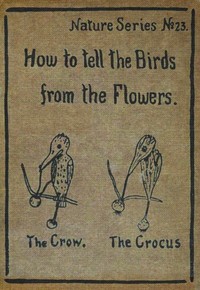
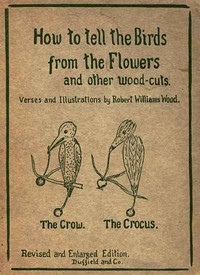
How to Tell the Birds from the Flowers: A Manual of Flornithology for Beginners — Story, Setting & Ideas
Fantasy Juvenile Worlds
4,471 recorded words. 0 minutes difference from this book's estimate.
View Gutenberg source #1593
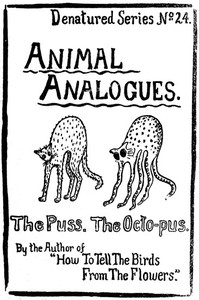
Before opening Animal Analogues: Verses and Illustrations — Edition Insights, the edition data offers a quick orientation: 4,584 words, 20 min estimated reading time, and 1 detected text section.
The text analysis averages about 23.4 words per sentence, while the detected sections provide another way to judge how the source is divided.
Project Gutenberg metadata also associates the work with “American wit and humor,” connecting these edition facts with the source record’s subject description.
Explore this collection
These alternatives are selected using recorded categories and estimated reading time.
About 20 minutes
Fantasy Juvenile Worlds
4,471 recorded words. 0 minutes difference from this book's estimate.
View Gutenberg source #1593About 19 minutes
Fantasy Juvenile Worlds
4,259 recorded words. 1 minutes difference from this book's estimate.
View Gutenberg source #67144About 25 minutes
Fantasy Juvenile Worlds
5,589 recorded words. 5 minutes difference from this book's estimate.
View Gutenberg source #47368Search stored excerpts and compare books → Choose by your preferences →
Choices use stored catalog measurements. Estimates vary with reading speed. A shared category is a catalog label, not a claim that two books have the same argument or literary quality.
Search reads excerpt text stored with this catalog and links to its associated Gutenberg record. The connection is stored in the site database; this tool does not recheck that every excerpt is word-for-word identical to that external record. Excerpt search does not cover every chapter and does not verify historical publication dates.
Catalog snapshot checked: 2026-09-25. Coverage: 91 public books, 91 available source excerpts.
Read the complete public-domain text at its original source.
Read on Project GutenbergRobert Williams Wood's Animal Analogues: Verses and Illustrations (1908) operates on a single, relentless joke: that a bee, a beet, and a beetle form an evolutionary lineage. Each poem pairs two creatures—or a creature and a plant—whose names share a syllable, then invents a visual or verbal link between them. The bunny's head becomes the tunny's tail; the octopus is a housecat with too many legs. Wood's verses are metrically precise, often deploying forced rhymes and mock-scholarly footnotes, as when he explains that the newt is a "Pneu-t" because of its need for air. The illustrations (not reproduced here) are essential to the conceit, but the text alone reveals a methodical absurdity: every entry follows the same pattern of false analogy, making the collection a sustained exercise in comic logic.
Wood treats language as a system of visual and phonetic coincidences that can be mistaken for biological relationships. The bee/beet/beetle sequence is presented as Darwinian descent, with the sugar beet and honey bee supplying the "pedigree." The ant's antennae are contrasted with the pheasant's lack thereof—a genuine anatomical difference—but the poem then asserts that the pheasant wears a red cap (its comb) to compensate. This slippage between real observation and pure invention is the collection's engine. In "The Hare. The Harrier," the harrier (a dog) is "harassed by the Hare," a pun that conflates the animal with the verb. Wood's footnotes, such as the one on "pneumos" for the newt, parody scientific apparatus while adding another layer of wordplay. The result is a book that asks readers to see language as a zoo of accidental resemblances.
The poems depend on a symmetry that is both graphic and phonetic. "The Eel. The Eelephant" plays on the shared initial "Eel-" to suggest that our aversion to eels colors our view of elephants' trunks—a joke about perspective. "The Puss. The Octo-pus" splits "octopus" into "octo-pus" to make it a cat with eight legs, then warns against domestic confusion. The typography itself enforces the pairing: each title uses a period and line break to separate the two terms, as if they were equal entries in a ledger. Wood also exploits the visual shape of words: "The Gnu" is spelled with a silent "g" that becomes a pun on "gnumerous" and "gnook." The poems are short, usually four to eight lines, and each ends with a punchline that resolves the false equivalence, often by revealing the pun that governed the whole comparison.
Wood's verses mimic the tone of Victorian natural history writing—earnest, classificatory, moralistic—while subverting it at every turn. The opening poem invokes Darwin, but only to justify a pun. The footnotes, like the one on "pneumos," imitate scholarly apparatus while explaining a joke. The table of contents lists entries as if they were species in a Linnaean catalogue, but the pairings are arbitrary: "The Antelope. The Cantelope" (antelope and cantaloupe) and "The P-Cock. The Q-Cumber" (peacock and cucumber) are pure phonetic play. Wood also includes an "Author's Add-end-'em" section, a self-referential pun on "addendum" that acknowledges the book's constructedness. The collection does not pretend to teach natural history; instead, it uses the conventions of scientific writing to generate humor, revealing how easily taxonomic language can be turned into nonsense.
Readers will get the most from Animal Analogues by reading each poem aloud, since the puns depend on sound as much as spelling. The illustrations, though absent from this text, are integral to the jokes—seek out the original 1908 edition to see how Wood drew the bee, beet, and beetle as a literal chain. The book rewards attention to its formal constraints: every poem is a closed system of two terms and one absurd connection. Approach it as a cabinet of linguistic curiosities rather than a nature guide.
That rainy afternoon, I kept returning to Wood’s playful sketches—each pun a small, quiet wink at nature’s oddities. The absurdity lingered, urging me toward something with a similar shrug at the world’s pretensions. I found myself lost in Ade’s Fables — Inside the Classic, whose sly animal voices felt like old, familiar company. The rain never stopped, and neither did the gentle laughter.
A brief reflection can help important ideas stay with you longer.