About 20 minutes
Animal Analogues: Verses and Illustrations — Edition Insights
Fantasy Juvenile Worlds
4,584 recorded words. 0 minutes difference from this book's estimate.
View Gutenberg source #43013
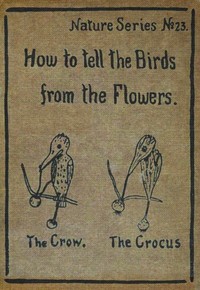
How to Tell the Birds from the Flowers: A Manual of Flornithology for Beginners — Story, Setting & Ideas can be approached with a clearer sense of reading commitment from its source measurements: 4,471 words, 20 min estimated reading time, and 1 detected text section.
The text analysis averages about 25.4 words per sentence, while the detected sections provide another way to judge how the source is divided.
Project Gutenberg metadata also associates the work with “American wit and humor,” connecting these edition facts with the source record’s subject description.
Explore this collection
These alternatives are selected using recorded categories and estimated reading time.
About 20 minutes
Fantasy Juvenile Worlds
4,584 recorded words. 0 minutes difference from this book's estimate.
View Gutenberg source #43013About 19 minutes
Fantasy Juvenile Worlds
4,259 recorded words. 1 minutes difference from this book's estimate.
View Gutenberg source #67144About 25 minutes
Fantasy Juvenile Worlds
5,589 recorded words. 5 minutes difference from this book's estimate.
View Gutenberg source #47368Search stored excerpts and compare books → Choose by your preferences →
Choices use stored catalog measurements. Estimates vary with reading speed. A shared category is a catalog label, not a claim that two books have the same argument or literary quality.
Search reads excerpt text stored with this catalog and links to its associated Gutenberg record. The connection is stored in the site database; this tool does not recheck that every excerpt is word-for-word identical to that external record. Excerpt search does not cover every chapter and does not verify historical publication dates.
Catalog snapshot checked: 2026-09-25. Coverage: 91 public books, 91 available source excerpts.
Read the complete public-domain text at its original source.
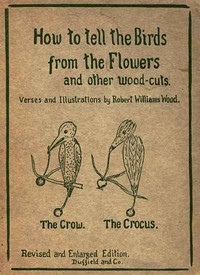
Read on Project GutenbergRobert Williams Wood's How to Tell the Birds from the Flowers (1907) presents itself as a field guide to a wholly imaginary discipline: flornithology. Each page pairs a bird and a plant whose names sound alike—crow and crocus, parrot and carrot, tern and turnip—and offers a short poem that pretends to distinguish them. The humor depends on the reader's willingness to accept that such confusion is possible. Wood's verses are built on puns, false etymologies, and deadpan misdirection: the rooster is said to have grown from a plant because both share the syllable 'roo'; the pelican and panicle are distinguished by spelling rather than biology. The book's illustrations, also by Wood, presumably reinforce the visual joke.
The poems treat language as a source of taxonomic confusion. Wood invents pseudo-scientific reasoning that relies entirely on homophony. The plover and clover, for instance, are told apart by noting that 'the Bee can be in Clover' while 'there is no B in Plover'—a joke that conflates entomology with etymology. The rue and rooster are separated by observing that 'the Rue lacks de-tail,' punning on both the bird's tail feathers and the word 'detail.' The hen and lichen are distinguished by tense: 'Hens lay, they lie.' These are not genuine identification tips but linguistic games that mock the very idea of a field guide.
The book's structure depends on symmetry: each spread pairs one bird and one plant, and the poems often mirror the paired names in their syntax. The table of contents lists the pairs in rhyming couplets: 'The Bird. The Burdock.' / 'The Clover. The Plover.' This pattern extends to the verse forms, which are mostly rhymed couplets or quatrains with regular meter. Wood occasionally breaks the pattern for effect, as in 'The Puffin. Nuffin,' where the second term is a nonsense word. The illustrations—though not fully visible in the text—likely complete the visual-verbal pun, showing a bird that resembles the plant or vice versa.
Wood's preface, titled 'Author's Apology,' acknowledges the absurdity of his project. The opening poem on the bird and burdock admits that 'even Mr. Burbank can't / Transform a Bird into a Plant!'—a reference to the real-life plant breeder Luther Burbank. This self-awareness pervades the book: the poems wink at the reader, acknowledging that the distinctions they offer are spurious. The crow and crocus poem notes that 'the noisy, cawing Crows all come, / Obedient to the Cro'custom,' a pun on 'caucus' that implies the birds are holding a political meeting. The humor lies not in accurate identification but in the playful pretense that such a manual is needed.
Wood's manual rewards readers who enjoy wordplay and the gentle mockery of scientific classification. The poems are best read aloud to catch the puns and rhythms. Because the humor depends on the pairing of names, the book can be opened at any page. Readers familiar with early twentieth-century American humor or the tradition of nonsense verse will find particular pleasure in Wood's precise, absurd logic.
That rainy afternoon, Wood’s silly flornithology kept me smiling—his gentle proof that naming things can be joyful play. When the storm faded, I lingered on his playful blur between categories and reached for something else off the shelf, almost without thinking. Crome Yellow — Background and Themes felt like a quiet echo, but sharper, where the joke wore a knowing grin. One book laughed; the other, remembered.
Save your reaction, strongest insight, and memorable passage.