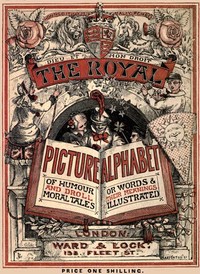
John Leighton, writing under the pseudonym Luke Limner, presents an alphabet book that is as much a moral instruction manual as a primer. Each letter introduces a word—such as 'Ablution,' 'Barter,' or 'Catastrophe'—followed by a short verse that often undercuts the expected lesson with irony or dark humor. The preface advises preceptors that 'with learning may laughter be found,' signaling a deliberate blend of amusement and edification.
The verses are populated with characters like the sooty sweep, Master Mack, and Lady Townsend, whose mishaps and misdeeds illustrate the definitions. The tone is consistently wry: the boy who washes his face with soap only to rub it in his eyes, or the schoolboys bathing when they should be in class, suggest that learning here is a playful, sometimes subversive, affair.
Moral Lessons in Miniature
Each letter entry functions as a compressed moral fable. The definitions are formal—'Ablution, The Act of Cleansing'—but the verses immediately complicate them. The little sweep's ablution results in soap in his eyes, a practical joke on cleanliness. 'Barter' shows Master Mack trading fruit for a skipping rope, but the verse implies a sly manipulation: 'He knows he’ll soon have Lucy’s rope.' The moral is often embedded in the consequence: Ichabod crams jam until he disagrees, teaching moderation through discomfort.
Leighton frequently uses animal comparisons to highlight human folly. The pig's obstinacy is 'nature,' but children who are stubborn are rebuked. The horse that knows Jemmy Small and 'what he holds behind' introduces a knowing, almost conspiratorial humor. These miniature dramas are designed to be memorable, using vivid, slightly absurd scenarios to fix both the word and its moral in the child's mind.
Visual and Verbal Irony
The book's structure relies on a tension between the formal definition and the playful verse. The definition of 'Catastrophe' as 'a Final Event (generally unhappy)' is immediately followed by Mrs. Blossom's cry over her dying fish—a domestic, almost trivial catastrophe. This gap between the grand term and the mundane event is a recurring pattern, inviting children to see the humor in mismatched registers.
Similarly, 'Eccentricity' is illustrated by a scene where 'everything is mis-applied,' a meta-commentary on the book's own method. The verse for 'Fraud' shows Pat Murphy asleep while Neddy Bray watches, but the thief is the one 'fast asleep,' subverting expectations. Leighton's verses often leave the moral ambiguous: the boy imitating a gentleman with a street-door key is 'unconscious' of the mimicry, but the reader is in on the joke.
A Pedagogical Balancing Act
The preface explicitly addresses preceptors, advocating for a method that combines 'descriptions and pictures' to make learning 'attractive and clear.' The publisher's advertisement at the end reinforces this: 'With the young it is necessary to speak to the Eye, as well as to the Mind.' Leighton's alphabet is thus a practical demonstration of this philosophy, where each page pairs a visual image (described in the verse) with a verbal lesson.
Yet the book is not uniformly earnest. The verse for 'Delightful' shows boys bathing when they should be at school, and the master is coming—but the delight is in the transgression. 'Horror' mocks Lady Townsend's fear of a harmless frog. These moments suggest that the book's primary allegiance is to entertainment, using the moral framework as a pretext for witty observation. The result is a primer that teaches not just letters, but a certain slyness of perspective.
Readers approaching The Royal Picture Alphabet should attend to the interplay between the formal definitions and the mischievous verses. The book rewards attention to its recurring patterns—the gap between word and deed, the use of animals to mirror human behavior, and the gentle mockery of adult pretensions. It is a work that expects its young audience to be both instructed and amused, and it trusts them to recognize the irony in its lessons.
That rainy afternoon, Leighton’s alphabet felt less like a lesson than a quiet, knowing wink between generations. His mischievous letters lingered, and afterward, I found myself reaching for something gentler, almost by accident. The same playful patience seemed to hum beneath the pages of The day's play — A Closer Reading, as if both books remembered what childhood truly felt like: unhurried, curious, and full of secret smiles.