About 204 minutes
Nye and Riley's Wit and Humor (Poems and Yarns) — Edition Insights
Science Fiction Utopias
46,708 recorded words. 8 minutes difference from this book's estimate.
View Gutenberg source #30131
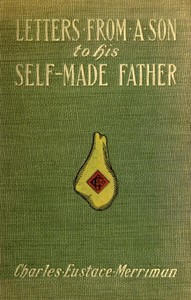
Before opening Letters from a Son to His Self-Made Father Being the Replies to Letters from a Self-Made Merchant to His Son — Inside the Classic, the edition data offers a quick orientation: 48,685 words, 3 hr 32 min estimated reading time, and 5 detected text sections.
The text analysis averages about 19.1 words per sentence, while the detected sections provide another way to judge how the source is divided.
Project Gutenberg metadata also associates the work with “Humorous stories,” connecting these edition facts with the source record’s subject description.
Explore this collection
These alternatives are selected using recorded categories and estimated reading time.
About 204 minutes
Science Fiction Utopias
46,708 recorded words. 8 minutes difference from this book's estimate.
View Gutenberg source #30131About 196 minutes
Science Fiction Utopias
44,923 recorded words. 16 minutes difference from this book's estimate.
View Gutenberg source #6313About 238 minutes
Science Fiction Utopias
54,718 recorded words. 26 minutes difference from this book's estimate.
View Gutenberg source #18934Search stored excerpts and compare books → Choose by your preferences →
Choices use stored catalog measurements. Estimates vary with reading speed. A shared category is a catalog label, not a claim that two books have the same argument or literary quality.
Search reads excerpt text stored with this catalog and links to its associated Gutenberg record. The connection is stored in the site database; this tool does not recheck that every excerpt is word-for-word identical to that external record. Excerpt search does not cover every chapter and does not verify historical publication dates.
Catalog snapshot checked: 2026-09-25. Coverage: 91 public books, 91 available source excerpts.
Read the complete public-domain text at its original source.
Read on Project GutenbergThis book reverses the usual direction of paternal advice. Instead of a father lecturing his son, Pierrepont Graham, a Harvard freshman, writes to his self-made father John in Chicago, turning the older man's business maxims back on him. The son's letters are a running commentary on how college life—art courses, dormitory flats, and social rituals—fails to align with the father's gospel of hustle and profit.
The structure is strictly epistolary: twenty numbered letters, each a reply to an unseen paternal epistle. The reader infers the father's voice only through the son's responses, a technique that keeps the comedy implicit and the father's character a blank to be filled by imagination.
Pierrepont consistently adopts his father's own language of commerce to describe non-commercial activities. He calls art appreciation “one of the most expensive courses in the curriculum” and justifies a five-room apartment as necessary for “peace” and “culture.” The father's phrase “red label on your brand of success” is echoed when the son speaks of being “terribly disturbed in my course” if bills go unpaid. This mimicry is not deference but a form of parody: the son uses the father's terms to expose their absurdity when applied to college life.
The letters also invert the father's expected role. Where the father likely dispenses advice, the son offers unsolicited counsel—convincing his mother to leave her money with him, for instance, and framing it as filial concern. The humor lies in the son's deadpan adoption of the father's pragmatic tone while pursuing entirely different ends.
The father's pork-packing business provides a steady stream of metaphors. Pierrepont complains of being “always on the hog,” and a Boston salesman quips that Circe turned men into hogs while Pierrepont tries to “turn hogs into men.” The image recurs in a traveling-salesman anecdote where the son claims to be “handicapped” to two sales a day, then admits it's an exaggeration—but, as he notes, “you've got to impress the world with the fact that you're some pumpkins or you won't get assessed at even cucumbers.”
These agricultural and animal references tie the son's world to the father's industry even when the son is far from Chicago. They create a verbal tether, reminding the reader that the father's worldview is never fully escaped, only reframed.
Letter No. I moves from Cambridge to a hotel lobby full of drummers, then to a train station, and back to the dormitory. This restless shifting mirrors the son's attempt to reconcile his father's world with his own. The hotel scene is a set piece: a competition in sales boasts, culminating in the quiet man who sells “suspension bridges”—one sale a year. The punch line deflates the others' bragging, and the son's narration undercuts the father's ethos of constant hustle.
The station scene introduces Job Withers, a rival storyteller, who is literally knocked over by a mail bag from the Inter-state Express. The son uses this accident to reclaim narrative authority: “When Job tries to cut me out of a trade with his stories, I'll make him the hero of one of mine.” The episode shows the son learning to control his own story, a skill he will need in his ongoing correspondence with his father.
Because the father's letters are never reproduced, the reader must reconstruct his character from the son's replies. The father is implied to be a man of maxims—“business promptness,” “red label on your brand of success”—but his personality remains a silhouette. This structural choice forces attention on the son's voice and his selective reporting. He mentions his mother's visit, his flat, his art studies, and his social life, but we never learn the father's direct responses.
The gap between letters creates a sense of ongoing conversation, but also of evasion. The son may be telling his father what he wants to hear, or what will amuse him, or what will justify expenses. The reader is left to guess which. This ambiguity is the engine of the comedy: we are always aware that the father is being managed, not informed.
Readers coming to this book after Lorimer's original will find the roles neatly reversed: the son now writes the lessons, and the father must read them. The humor depends on knowing the earlier work, but the parody stands alone as a portrait of a young man learning to talk back in his father's language. Pay attention to the son's asides—they often carry the sharpest point.
I keep thinking about that parody where the son turns his father’s business talk back on him—so funny, yet strangely tender. It reminded me of a quiet companion I revisited, More Fables — Reading Notes, which lingers in a similar way, not lecturing, just sitting with you afterwards like a good friend’s pause.
Use these questions to collect your thoughts before moving on.