About 204 minutes
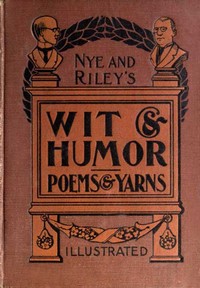
Nye and Riley's Wit and Humor (Poems and Yarns) — Edition Insights
Science Fiction Utopias
46,708 recorded words. 8 minutes difference from this book's estimate.
View Gutenberg source #30131
Masterpieces of American Wit and Humor — Story, Setting & Ideas can be approached with a clearer sense of reading commitment from its source measurements: 44,923 words, 3 hr 16 min estimated reading time, and 4 detected text sections.
The text analysis averages about 24.1 words per sentence, while the detected sections provide another way to judge how the source is divided.
Project Gutenberg metadata also associates the work with “American wit and humor,” connecting these edition facts with the source record’s subject description.
Explore this collection
These alternatives are selected using recorded categories and estimated reading time.
About 204 minutes
Science Fiction Utopias
46,708 recorded words. 8 minutes difference from this book's estimate.
View Gutenberg source #30131About 212 minutes
Science Fiction Utopias
48,685 recorded words. 16 minutes difference from this book's estimate.
View Gutenberg source #54880About 238 minutes
Science Fiction Utopias
54,718 recorded words. 42 minutes difference from this book's estimate.
View Gutenberg source #18934Search stored excerpts and compare books → Choose by your preferences →
Choices use stored catalog measurements. Estimates vary with reading speed. A shared category is a catalog label, not a claim that two books have the same argument or literary quality.
Search reads excerpt text stored with this catalog and links to its associated Gutenberg record. The connection is stored in the site database; this tool does not recheck that every excerpt is word-for-word identical to that external record. Excerpt search does not cover every chapter and does not verify historical publication dates.
Catalog snapshot checked: 2026-09-25. Coverage: 91 public books, 91 available source excerpts.
Read the complete public-domain text at its original source.
Read on Project GutenbergThomas L. Masson's 1903 collection Masterpieces of American Wit and Humor opens with Agnes Repplier's essay 'A Plea for Humor,' which immediately sets a defensive tone: Repplier laments a 'drab-colored world' and the scarcity of 'merry fools.' This framing suggests the anthology is not merely a gathering of comic pieces but a deliberate counterweight to what the editor perceived as an era of oppressive earnestness. The volume's contents—ranging from Seba Smith's rustic dialect to Artemus Ward's deadpan business letters—reveal a consistent authorial choice: humor rooted in vernacular speech, regional character, and understated absurdity rather than punchline-driven jokes.
Seba Smith's 'My First Visit to Portland' exemplifies how the anthology uses nonstandard speech to generate humor. The narrator's voice is thick with colloquialisms: 'I tackled up the old horse,' 'ropped me up another shirt,' and 'I didn't know what a steamboat was any more than the man in the moon.' The comedy arises not from plot but from the gap between the narrator's naive perspective and the reader's broader knowledge. When the Portland editor advises him to 'go ahead' like steamboats, the humor depends on the narrator's literal-mindedness. Masson's inclusion of such pieces privileges character over incident, making dialect a primary vehicle for wit.
Several selections in the volume follow a pattern: a guileless protagonist ventures into a sophisticated setting and outwits or is outwitted by its inhabitants. In Smith's story, the narrator deliberately enters 'Hucklers' Row' to test whether Portland sharpers can 'twist my eye-teeth out.' The bargaining scene—biscuits at two cents for three—unfolds with a deadpan logic that mocks both the seller's pretense and the buyer's faux naivete. This structure recurs in Artemus Ward's 'One of Mr. Ward's Business Letters,' where the showman's exaggerated earnestness undercuts commercial transactions. Masson's editorial eye favors tales where innocence is a weapon, not a weakness.
Unlike the broad farce of some contemporaries, the humor in this anthology often relies on underplayed reactions. When Smith's narrator sees the editor's tears and his mother's 'hearty crying spell,' he responds with a laconic 'This made me feel rather bad for a minit or two.' The emotional stakes are deflated by the narrator's flat delivery. Similarly, in 'The Harp of a Thousand Strings,' Joshua S. Morris builds a mock-sermon that escalates to absurd heights only to collapse into anticlimax. Masson's selections consistently reward readers who attend to tone and timing rather than slapstick.
The anthology's subtitle might have been 'American' in the broadest sense, but its contents are heavily Northeastern and Midwestern. Smith's Maine dialect, Holley's New England spinster, and Browne's Ohio showman create a patchwork of regional types. Yet the humor rarely mocks these voices; instead, it treats them as authentic expressions of character. Repplier's opening essay argues for humor as a civilizing force, and Masson's choices bear this out: the comic figures are not butts of jokes but survivors who navigate a changing nation with wit. The volume thus becomes a kind of folk archive, preserving speech patterns and social attitudes of the late nineteenth century.
Readers approaching this collection should listen for the cadence of each piece—the drawl, the pause, the deliberate misdirection. Masson has curated not a series of punchlines but a gallery of American voices, each with its own rhythm and logic. The humor works best when taken slowly, allowing the dialect to settle and the understatement to register. Whether encountering Artemus Ward's business letters or Seba Smith's Portland adventures, the pleasure lies in the telling, not the tale.
The rain made the old anthology’s pages cling together, and I slowed down, savoring Masson’s dry jokes about human folly. That afternoon’s quiet laughing reminded me of something else, a gentler, stranger collection of moral tales, so I found myself drifting to Fantastic Fables — Inside the Classic and just sat there with both, forgetting the weather entirely.
Use these questions to collect your thoughts before moving on.