About 254 minutes
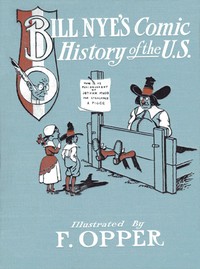
Comic History of the United States — Themes and Context
Science Fiction Utopias
58,365 recorded words. 16 minutes difference from this book's estimate.
View Gutenberg source #21427
The catalog record for My Lady Nicotine: A Study in Smoke — A Closer Reading provides practical reading context through 54,718 words, 3 hr 58 min estimated reading time, and 9 detected text sections.
The text analysis averages about 18.5 words per sentence, while the detected sections provide another way to judge how the source is divided.
Project Gutenberg metadata also associates the work with “Wit and humor, Pictorial,” connecting these edition facts with the source record’s subject description.
Explore this collection
These alternatives are selected using recorded categories and estimated reading time.
About 254 minutes
Science Fiction Utopias
58,365 recorded words. 16 minutes difference from this book's estimate.
View Gutenberg source #21427About 212 minutes
Science Fiction Utopias
48,685 recorded words. 26 minutes difference from this book's estimate.
View Gutenberg source #54880About 204 minutes
Science Fiction Utopias
46,708 recorded words. 34 minutes difference from this book's estimate.
View Gutenberg source #30131Search stored excerpts and compare books → Choose by your preferences →
Choices use stored catalog measurements. Estimates vary with reading speed. A shared category is a catalog label, not a claim that two books have the same argument or literary quality.
Search reads excerpt text stored with this catalog and links to its associated Gutenberg record. The connection is stored in the site database; this tool does not recheck that every excerpt is word-for-word identical to that external record. Excerpt search does not cover every chapter and does not verify historical publication dates.
Catalog snapshot checked: 2026-09-25. Coverage: 91 public books, 91 available source excerpts.
Read the complete public-domain text at its original source.
Read on Project GutenbergJ. M. Barrie's My Lady Nicotine: A Study in Smoke opens with a chapter titled "Matrimony and Smoking compared," immediately establishing the book's central comic tension: the conflict between domestic obligations and the bachelor's devotion to tobacco. The narrator's voice is arch and self-mocking, treating pipe-smoking as a serious pursuit while undercutting that seriousness with absurd detail. The Arcadia Mixture, a fictional tobacco blend, becomes a character in its own right, binding a circle of male friends in rituals that are lovingly catalogued. Barrie's prose is dense with ironic asides and elaborate metaphors, as when he compares a smoker's attachment to his pipe to a lover's devotion. The illustrations by Maurice Prendergast add a visual dimension to this world of smoke and whimsy.
The Arcadia Mixture is more than a tobacco; it is the organizing principle of the narrator's social world. In chapter III, the mixture is introduced with mock solemnity, and its devotees are "only to be distinguished by our pipes." The blend becomes a password, a bond that transforms acquaintances into confederates. Barrie devotes entire chapters to the mixture's properties, its preparation, and the lengths to which smokers go to secure it. The narrator's friend Jimmy pins a notice on his door, a detail that suggests the mixture's quasi-religious importance. The Arcadia Mixture even appears in the title of two chapters, and its absence in chapter XXIV is treated as a crisis. This repeated focus turns a commercial product into a symbol of shared identity and male camaraderie.
Barrie's humor often arises from elaborate misunderstandings, as seen in the Scrymgeour episode. Scrymgeour, mistaken for a wealthy suitor, becomes entangled with a lady and her father. The father's indignation is punctured by his own confusion: he recognizes Scrymgeour by his "velvet coat and broad hat." The lady's tears "became her vastly," and Scrymgeour, bewildered, ends up with his arm around her. The narrator is called in to intercede but refuses, blaming Scrymgeour's predicament on the Arcadia Mixture. The scene is a farce of mistaken identity, where characters act on incomplete information and the reader enjoys the gap between what they know and what the characters perceive. Barrie's dialogue is crisp, with characters speaking in short, ironic exchanges that heighten the absurdity.
Barrie's diction elevates trivial subjects to mock-heroic heights. Smoking is described in terms of love and loyalty: the title itself personifies nicotine as a lady. The narrator speaks of his pipes with the devotion of a collector, and the loss of a tobacco pouch is treated as a tragedy. In chapter V, the pouch is cast out a window and "never quite recovered from its night in the rain." The language is deliberately inflated, with phrases like "the grandest scene in history" applied to a smoking-related event. This tone is sustained by a dry, understated delivery that never winks too broadly. The effect is a comedy of manners where the objects of mockery—smoking, male bonding, domestic evasion—are treated with affectionate irony.
Barrie builds his sketches around a set of recurring objects and rituals. Pipes are described with loving specificity: meerschaums, cherry-wood stems, and the paraphernalia of cleaning and packing. The smoking-table in chapter VI is a miniature stage where spills, jars, and trays are arranged. The narrator's wife appears as a foil, her hand on his shoulder a signal of interruption. The house-boat "Arcadia" is a retreat where the smokers gather, and its name echoes the tobacco blend. These details create a consistent world where every object has a history and every habit a justification. Barrie's method is accumulative: each chapter adds another layer to the mythology of the Arcadia smokers, so that the book becomes a kind of mock-epic of domestic life and its small rebellions.
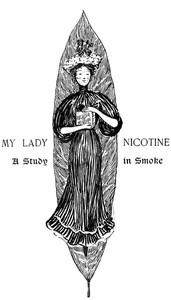
Maurice Prendergast's illustrations complement Barrie's text with a whimsical, decorative style. The headpieces and tailpieces depict smokers in various attitudes—puffing, gesturing, lost in thought. The illustrations are not merely ornamental; they reinforce the book's tone of gentle mockery. For instance, the image of a woman with a cigarette in her mouth (from the Scrymgeour episode) visually echoes the text's theme of gender and smoking. Prendergast's linework is fluid, and his compositions often include pipes, pouches, and smoke as formal elements. The illustrations help to establish the period setting and the lighthearted mood, making the book a collaborative work where image and text are in harmony.
Readers approaching My Lady Nicotine should expect not a novel but a series of linked sketches held together by a shared tone and a recurring cast. Barrie's prose rewards attention to its ironic cadences and its precise, often absurd, observations. The book is best enjoyed in short sittings, allowing each chapter's comic situation to land without the pressure of a continuous plot. The Arcadia Mixture, whatever its real-world counterpart, is best understood as a literary device—a catalyst for the rituals and misunderstandings that give the book its charm.
There’s something about My Lady Nicotine that brings back the quiet hush of a room after the last match is struck. That same ache for vanished rituals surfaces in The Incubator Baby — Text and Context, where new warmth meets old uncertainties. I keep turning the pages, less for plot than for that flicker of recognition.
Capture what you thought, learned, and would like to remember.