About 62 minutes
The Incubator Baby — Text and Context
Science Fiction Utopias
14,242 recorded words. 3 minutes difference from this book's estimate.
View Gutenberg source #44219
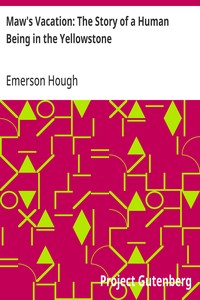
Before opening Maw's Vacation: The Story of a Human Being in the Yellowstone — Reading Notes, the edition data offers a quick orientation: 13,492 words, 59 min estimated reading time, and 2 detected text sections.
The text analysis averages about 19.9 words per sentence, while the detected sections provide another way to judge how the source is divided.
Project Gutenberg metadata also associates the work with “American wit and humor,” connecting these edition facts with the source record’s subject description.
Explore this collection
These alternatives are selected using recorded categories and estimated reading time.
About 62 minutes
Science Fiction Utopias
14,242 recorded words. 3 minutes difference from this book's estimate.
View Gutenberg source #44219About 39 minutes
Science Fiction Utopias
8,967 recorded words. 20 minutes difference from this book's estimate.
View Gutenberg source #61624About 95 minutes
Science Fiction Utopias
21,841 recorded words. 36 minutes difference from this book's estimate.
View Gutenberg source #37166Search stored excerpts and compare books → Choose by your preferences →
Choices use stored catalog measurements. Estimates vary with reading speed. A shared category is a catalog label, not a claim that two books have the same argument or literary quality.
Search reads excerpt text stored with this catalog and links to its associated Gutenberg record. The connection is stored in the site database; this tool does not recheck that every excerpt is word-for-word identical to that external record. Excerpt search does not cover every chapter and does not verify historical publication dates.
Catalog snapshot checked: 2026-09-25. Coverage: 91 public books, 91 available source excerpts.
Read the complete public-domain text at its original source.
Read on Project GutenbergEmerson Hough's 1921 comic novella opens with a long, unbroken monologue from Maw, a farm wife who has spent forty years cooking, cleaning, and raising children while her husband Paw “kicks about the crops and prices.” Her voice is immediate and colloquial: “Times has changed, says Maw to herself, says she.” She contrasts her past drudgery—no movies, no “nut sundaes,” only temperance lectures showing “the inside of a drunkard's stomach”—with the present, where an automobile sits in the yard and a daughter has returned from college. The humor depends on her precise, aggrieved catalog of domestic labor and her wry observation that “things gets raised” despite Paw's complaints.
The opening excerpt establishes Maw as a narrator who thinks in lists. She enumerates chores—“cooking, sweeping, washing and ironing, suchlike”—and entertainments she missed: church sociables, surprise parties, the occasional traveling lecturer. Her grievances are concrete: she “never seen nothing or went nowhere,” and even a lemonade would have been deemed “frivolous conduct.” Yet the monologue is not purely bitter. She notes that “the last few years we somehow have had more clothes and things, and more money in the bank,” and that her daughter Cynthy's college education is “all paid for somehow.” This mix of complaint and grudging acknowledgment gives her voice a lived-in authenticity. Hough avoids sentimentality; Maw's humor comes from her deadpan delivery and the sheer density of remembered detail.
Later in the text, the narrative shifts to the Yellowstone park superintendent, who receives a letter from “Maw, sixty thousand of her.” His imagined reply is a single, breathless sentence listing his duties: “tell the rangers where to let the hotels cut wood and where to run their milk herd and how to feed the hay crews … get the elk counted again and the antelope estimated and stop the sale of elk teeth.” The list runs for over a dozen lines, mimicking the rhythm of Maw's own catalog but substituting bureaucratic chaos for domestic labor. The superintendent is “contrite because of his past” and “patient when he replies,” but his patience is belied by the absurd accumulation of tasks. This structural parallel—two long, unpunctuated inventories—suggests that Hough is satirizing not just tourism but the machinery that enables it.
The excerpts place two worlds in tension: Maw's domestic sphere, where time is measured by “shoveling snow and carrying more coal,” and the park's administrative sphere, where the superintendent must “wire the Shriners that I will meet them at the train” and “write Congressman Jones that his trip is all arranged for.” The park itself is barely described; instead, it functions as a backdrop for competing voices. Maw's questions—about the price of gas, the naming of geysers, whether “there is church on Sundays”—are both earnest and absurd, revealing her lack of familiarity with the scale of the national park. The superintendent's reply, when it finally comes, is deferred by a list of obligations so long that it becomes a parody of efficiency. The humor depends on the reader recognizing that neither speaker fully understands the other's world.
Hough anchors his comedy in specific 1920s references: “Kapoks” cameras, “mail-order store” jobs, “daylight-saving contraptions,” and the “Republican Administration” blamed for mosquitoes. These details prevent the satire from floating into generic complaint. Maw's world is one where a “maid” is a newfangled term for hired help, and where a trip to Yellowstone represents a radical break from a life spent “down town after the groceries.” The superintendent's world, by contrast, is filled with “topographic maps,” “Appropriations Committees,” and “colored prints of Old Faithful.” The collision is not just between rural and urban, but between two kinds of expertise: the intimate knowledge of domestic survival and the professional knowledge of park management. Hough never resolves this tension; he simply lets both voices run.
The excerpts cover only the opening and a middle section. It is unclear whether Maw ever reaches Yellowstone, whether the superintendent ever answers her letter, or whether the story maintains its dual-voice structure throughout. The catalog subjects—American wit and humor, camping, Yellowstone National Park, tourists—suggest a comic travel narrative, but the excerpts offer no plot progression. Readers should expect a series of set pieces rather than a conventional arc. The humor is cumulative, built on repetition and specificity, and may reward those who enjoy period slang and bureaucratic parody. The novella's brevity (under 14,000 words) means it can be read in a single sitting, ideally with attention to the rhythm of its lists.
Because the excerpts are limited to the opening and one later passage, readers should approach the full text as a comic sketch rather than a plotted novel. Hough's technique relies on accumulation: the more Maw lists her grievances, and the more the superintendent lists his duties, the funnier each becomes. The novella may be best enjoyed as a period piece, its humor rooted in the specific anxieties of early automobile tourism and the expanding federal bureaucracy. Pay attention to how Hough varies the length and content of each monologue, and whether the two voices ever converge.
Reading about Maw’s chattering distraction from Yellowstone’s grandeur, I remembered my own first trip west, when I could scarcely see the peaks for worrying about train connections. Years later, The Fall of Ulysses: An Elephant Story — Context and Discussion gave me that same ache—the way a creature’s stubborn inner world can blot out the biggest landscape. We carry our little troubles everywhere, don’t we?
Save your reaction, strongest insight, and memorable passage.