About 254 minutes
Comic History of the United States — Themes and Context
Science Fiction Utopias
58,365 recorded words. 43 minutes difference from this book's estimate.
View Gutenberg source #21427
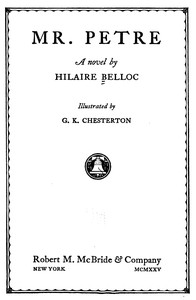
The catalog record for Mr. Petre — Context and Discussion provides practical reading context through 68,116 words, 4 hr 57 min estimated reading time, and 13 detected text sections.
The text analysis averages about 15.3 words per sentence, while the detected sections provide another way to judge how the source is divided.
Project Gutenberg metadata also associates the work with “Satire,” connecting these edition facts with the source record’s subject description.
Explore this collection
These alternatives are selected using recorded categories and estimated reading time.
About 254 minutes
Science Fiction Utopias
58,365 recorded words. 43 minutes difference from this book's estimate.
View Gutenberg source #21427About 341 minutes
Science Fiction Utopias
78,306 recorded words. 44 minutes difference from this book's estimate.
View Gutenberg source #39933About 238 minutes
Science Fiction Utopias
54,718 recorded words. 59 minutes difference from this book's estimate.
View Gutenberg source #18934Search stored excerpts and compare books → Choose by your preferences →
Choices use stored catalog measurements. Estimates vary with reading speed. A shared category is a catalog label, not a claim that two books have the same argument or literary quality.
Search reads excerpt text stored with this catalog and links to its associated Gutenberg record. The connection is stored in the site database; this tool does not recheck that every excerpt is word-for-word identical to that external record. Excerpt search does not cover every chapter and does not verify historical publication dates.
Catalog snapshot checked: 2026-09-25. Coverage: 91 public books, 91 available source excerpts.
Read the complete public-domain text at its original source.
Read on Project GutenbergBelloc opens Mr. Petre with a precise temporal marker—"It was the 3rd of April, 1953"—and immediately establishes a future where rotors have replaced steamships and passports have been abolished for Englishmen. The protagonist, a short, stout man with Americanized speech, is returning to England after two years abroad. This initial scene, rich in concrete detail (his American clothes, the locked dispatch box), sets the stage for a narrative that will intertwine speculative technology with sharp social observation.
The novel's satirical tone emerges early through its treatment of finance and monopoly. Belloc's prose is brisk and ironic, as when he notes that the protagonist "hated his pockets bulging with papers"—a small but telling character note. The illustrations by G. K. Chesterton further underscore the work's comic and grotesque elements.
The novel's speculative setting is not merely decorative; it drives the plot. Belloc imagines a 1953 where the "British Amalgamated Rotors" (B.A.R.) has achieved a near-total monopoly on transportation, from ships to elevators. The narrative details the mechanics of this control: competing systems cannot link up because "a boat make harbor in a difficult channel at night" requires a rotor attuned to the shore's system. This technical specificity lends credibility to the satire.
Belloc also sketches the ruthless logic of monopoly capitalism. Henry Trefusis, a financier, decides not to compete with tidal power but to "use his political connection to kill them, as railways had killed canals." The language is blunt and historical, drawing a direct line from 19th-century practices to this imagined future. The novel thus uses its futuristic trappings to critique enduring economic structures.
Belloc's diction in financial passages is precise and often ironic. Mr. Charlbury, a small-time speculator, undergoes a transformation: "He used to think in three figures; he was now thinking in five: and of such is the Kingdom of Heaven." The biblical echo deflates his ambition, framing it as both mundane and absurd.
The narrative voice frequently shifts between dry reportage and wry commentary. When Charlbury reads a newspaper paragraph about a ratepayers' meeting protesting rotor licenses, the text notes that "it was a paragraph that meant nothing to the millions that had seen it that morning." This aside underscores the gap between public indifference and the machinations of the powerful. Belloc's sentences are often short and declarative, lending a clipped, authoritative tone to even the most outlandish scenarios.
The catalog subjects list "mistaken identity" and "amnesia" as key elements, and the excerpts hint at these through the protagonist's disorientation. Mr. Petre is introduced as a man who "wondering who or what he may have been" (as the frontispiece caption states). This uncertainty fuels the plot's comic and satirical engine.
Belloc uses the confusion of identity to lampoon social pretensions. Characters like "Mrs. Cyril leaping to the telephone" and "His Grace the Proprietor of the 'Messenger' conferring the Order of the Boot" suggest a world where titles and appearances are paramount. The illustrations by Chesterton—such as "Mr. Petre wondering who or what he may have been"—reinforce the theme of fractured identity. The narrative never fully resolves the mystery within the provided excerpts, leaving the reader to infer that the amnesia is both a plot device and a metaphor for the fluidity of social status.
G. K. Chesterton's illustrations are integral to the novel's tone. The list of plates reveals a gallery of grotesque and exaggerated figures: "Sir Jeremiah Walton, God's servant," "The Partners" (depicted with bulbous noses and stern expressions), and "Dada Beeston" with her aristocratic lineage spelled out in mock-heroic detail. The captions themselves are satirical, such as "Minatory but Patient Admonishment of the Ignoble Algernon by Breeches of Bolter's Club."
The illustrations often capture moments of absurd confrontation or bureaucratic pomposity. For instance, "The Great Specialist wrote:—'Special circumstances: A Bastard'" suggests a legal or medical farce. Chesterton's style—bold lines, exaggerated features, and crowded compositions—complements Belloc's prose, which similarly skewers pretension through hyperbole. Together, text and image create a unified satirical vision of a world where finance, class, and identity are all subject to comic distortion.
Readers approaching Mr. Petre should attend to the interplay between Belloc's speculative future and his pointed social critique. The novel rewards attention to its economic jargon and bureaucratic absurdities, which are never merely decorative. Chesterton's illustrations offer a visual key to the satire, often amplifying the text's mockery. While the excerpts do not reveal the full resolution of Mr. Petre's identity, the journey through this world of rotors, monopolies, and mistaken identities is the novel's true focus.
There’s something almost tender about Belloc’s satire—how the millionaire’s blankness lets everyone else project their own frantic schemes onto him. It reminded me, oddly, of the quieter melancholy in Those barren leaves — Themes and Context, where the same hollowness lingers, but without the laughter. I still think about that contrast on slow evenings.
A brief reflection can help important ideas stay with you longer.