About 752 minutes
Watch Yourself Go By — Context and Discussion
Science Fiction Utopias
172,804 recorded words. 279 minutes difference from this book's estimate.
View Gutenberg source #20375
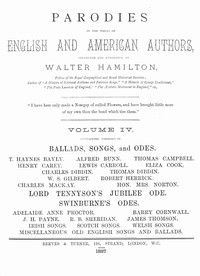
This digital edition of Parodies of the works of English & American authors, vol. IV — Inside the Classic is described by source-level measurements including 237,036 words, 17 hr 11 min estimated reading time, and 58 detected text sections.
The text analysis averages about 18.4 words per sentence, while the detected sections provide another way to judge how the source is divided.
Project Gutenberg metadata also associates the work with “Parodies,” connecting these edition facts with the source record’s subject description.
Explore this collection
These alternatives are selected using recorded categories and estimated reading time.
About 752 minutes
Science Fiction Utopias
172,804 recorded words. 279 minutes difference from this book's estimate.
View Gutenberg source #20375About 564 minutes
Science Fiction Utopias
129,612 recorded words. 467 minutes difference from this book's estimate.
View Gutenberg source #74437About 419 minutes
Science Fiction Utopias
96,150 recorded words. 612 minutes difference from this book's estimate.
View Gutenberg source #47194Search stored excerpts and compare books → Choose by your preferences →
Choices use stored catalog measurements. Estimates vary with reading speed. A shared category is a catalog label, not a claim that two books have the same argument or literary quality.
Search reads excerpt text stored with this catalog and links to its associated Gutenberg record. The connection is stored in the site database; this tool does not recheck that every excerpt is word-for-word identical to that external record. Excerpt search does not cover every chapter and does not verify historical publication dates.
Catalog snapshot checked: 2026-09-25. Coverage: 91 public books, 91 available source excerpts.
Read the complete public-domain text at its original source.
Read on Project GutenbergWalter Hamilton's fourth volume of Parodies trains its focus on ballads, songs, and odes, drawing from a roster that includes T. Haynes Bayly, Lewis Carroll, W. S. Gilbert, and Swinburne. The excerpts show a consistent method: the parodist retains the original's meter and stanza structure while swapping in a new subject—often a contemporary figure or type. For instance, a song about a fine old English gentleman is refashioned into a satire of a "Fine Old Heavy Villain" from melodrama, then into a lampoon of a "Fine Old Common Councilman" whose wife "dropped her H's" and who cannot speak French. The collection thus operates as a running commentary on Victorian society, using poetic form as a vehicle for critique.
The parodies in this volume rely heavily on the recognizability of their source meters. The excerpted sequence beginning with "A Fine Old English Gentleman" is adapted multiple times: first into a stage villain's lament, then into a Common Councilman's boast. Each version keeps the original's refrain structure ("The fine, &c." or "Like a fine old heavy villain") but fills the stanzas with new, often deflating content. The Councilman parody, for example, retains the ballad's four-stress lines while detailing his wife's illiteracy and his own vulgarity at a royal event. This technique allows the parody to function as both homage and critique—the reader's familiarity with the original tune or rhythm makes the substitution of low or ridiculous subject matter especially pointed.
The excerpts reveal a clear preference for satirizing public figures and institutions. The "Fine Old Common Councilman" parody, dated August 1851, mocks the City of London's governing body for its corruption and lack of refinement: the Councilman's wife "could not well speak English, not to say a word of French," and the poem predicts their downfall via The Times newspaper. Another parody, "A Variety of Vicars," contrasts the ideal of a good old English vicar with a type that is "well-nigh out of date." These pieces suggest that Hamilton's collection is not merely a literary exercise but a form of social commentary, using parody to needle specific classes and professions. The stage villain parody, meanwhile, targets theatrical conventions, referencing actors T. P. Cooke and N. T. Hicks as "heroes of the stage" from a bygone era.
Hamilton, identified as a Fellow of the Royal Geographical and Royal Historical Societies, frames the collection with a motto: "I have here only made a Nosegay of culled Flowers, and have brought little more of my own than the band which ties them." This suggests a curatorial rather than authorial role, though the arrangement itself imposes a structure. The volume is part of a four-volume set, with this installment focusing on ballads, songs, and odes. The table of contents shows a meticulous organization by original author or source, from T. Haynes Bayly to "Miscellaneous Old English Songs and Ballads." The excerpts include attributions such as "Anonymous (written about 1820)" and "The Month. August, 1851," indicating that Hamilton provided contextual notes. This editorial apparatus helps the reader situate each parody within its historical moment, though the excerpts do not reveal the full extent of his commentary.
Readers approaching this volume will find it most rewarding when they can identify the original poems being parodied—familiarity with the source texts sharpens the satire. The collection also rewards attention to the dates and attributions Hamilton supplies, which anchor each piece in a specific cultural moment. Whether the target is a stage convention, a civic institution, or a literary style, the parodies in this volume offer a window into Victorian humor and its methods of critique.
In Volume IV, those careful parodies cling to each song’s rhythm even while swapping romance for aldermen, a devotion to form that reminds me of a quieter stubbornness in The Idiot — Story, Setting & Ideas—how its gentle soul holds fast to goodness amidst absurdity. Both shelve near my heart: the winking mimic, the tender fool.
A brief reflection can help important ideas stay with you longer.