About 1,359 minutes
Parodies of the works of English & American authors, vol. VI — Context and Discussion
Adventure Picaresque Fiction
312,353 recorded words. 342 minutes difference from this book's estimate.
View Gutenberg source #70548
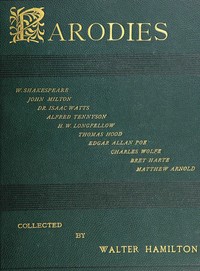
Parodies of the works of English & American authors, vol. II — Background and Themes can be approached with a clearer sense of reading commitment from its source measurements: 233,886 words, 16 hr 57 min estimated reading time, and 81 detected text sections.
The text analysis averages about 20.9 words per sentence, while the detected sections provide another way to judge how the source is divided.
Project Gutenberg metadata also associates the work with “Parodies,” connecting these edition facts with the source record’s subject description.
Explore this collection
These alternatives are selected using recorded categories and estimated reading time.
About 1,359 minutes
Adventure Picaresque Fiction
312,353 recorded words. 342 minutes difference from this book's estimate.
View Gutenberg source #70548About 664 minutes
Adventure Picaresque Fiction
152,539 recorded words. 353 minutes difference from this book's estimate.
View Gutenberg source #62396About 559 minutes
Adventure Picaresque Fiction
128,422 recorded words. 458 minutes difference from this book's estimate.
View Gutenberg source #50874Search stored excerpts and compare books → Choose by your preferences →
Choices use stored catalog measurements. Estimates vary with reading speed. A shared category is a catalog label, not a claim that two books have the same argument or literary quality.
Search reads excerpt text stored with this catalog and links to its associated Gutenberg record. The connection is stored in the site database; this tool does not recheck that every excerpt is word-for-word identical to that external record. Excerpt search does not cover every chapter and does not verify historical publication dates.
Catalog snapshot checked: 2026-09-25. Coverage: 91 public books, 91 available source excerpts.
Read the complete public-domain text at its original source.
Read on Project GutenbergWalter Hamilton's second volume of parodies, published in 1885, assembles imitations of major English and American poets, from Shakespeare to Bret Harte. The compiler, a Fellow of the Royal Geographical and Royal Historical Societies, frames parody not as mere buffoonery but as 'a critical exposition' that targets 'the absurdities of writers.' The excerpts show a deliberate method: Hamilton includes not only the parodies themselves but also contemporary correspondence, such as F. C. Burnand's detailed rationale for reworking The Tempest into an extravaganza. This editorial note examines how the catalog subjects—'Parodies' and 'general-literature'—align with the actual contents, which blend literary criticism, theatrical history, and anthology.
Hamilton's preface, quoting D'Israeli's Curiosities of Literature, asserts that parody 'will only strike at what is chimerical and false.' This principle is borne out in the selection: the volume targets poems so familiar that their inversion is immediately recognizable—'To be or not to be,' 'Excelsior,' 'My Mother,' and Wolfe's 'The Burial of Sir John Moore.' The compiler notes that subscriber demand expanded the collection from 'a few only of the best Parodies' to a near-comprehensive archive. He also explains the practical decision to spread parodies of a single short poem across multiple issues to avoid monotony. This reveals a tension between scholarly completeness and reader engagement, a dynamic that shapes the anthology's structure.
A substantial excerpt reproduces F. C. Burnand's letter defending his treatment of The Tempest. Burnand distinguishes his work from 'vulgar, coarse piece of buffoonery,' positioning it as an 'advance' on earlier burlesques. He reimagines Ariel as 'the spirit of enterprise' and Caliban as 'a backward boy' who 'wants to acquire knowledge.' Notably, he omits the tempest entirely, substituting a 'sea-fog,' and discards Trinculo and Stephano as unfunny. This detailed rationale—part of a public exchange with a critic—illustrates how Victorian burlesque writers theorized their craft. Hamilton includes such material not as parody itself but as contextual evidence, enriching the anthology beyond mere imitation.
The Project Gutenberg record assigns this volume to 'Adventure & Picaresque Fiction' and 'Parodies' as a subject. Yet the excerpts contain no adventure narrative; the work is a critical anthology with extensive prefatory matter, indexes, and correspondence. The 'general-literature' secondary topic is more accurate, but the primary category misleads. The volume's 81 text sections include parodies of Shakespeare, Milton, Dryden, Watts, Tennyson, Longfellow, Hood, Bret Harte, Matthew Arnold, Poe, and others—a range that reflects Hamilton's ambition to cover 'English and American authors' systematically. Readers expecting picaresque fiction will find instead a scholarly compendium of literary mimicry, annotated with bibliographic references and theatrical history.
Hamilton's collection rewards readers interested in the mechanics of parody and the cultural status of canonical works in the late nineteenth century. The excerpts reveal a compiler who treats parody as a serious literary form, supported by evidence from contemporary debates. Approach the volume as a reference work: use the index to locate parodies of specific poems, and read the prefatory material for insight into Victorian attitudes toward imitation and originality.
Leafing through Hamilton’s parodies, I kept noticing the eager, forgotten names beneath the satire—writers who once mattered, now just footnotes. It made me think of that odd old Who Was Who: 5000 B. C. to Date Biographical Dictionary of the Famous and Those Who Wanted to Be — Reading Companion, and how gently it holds those who almost were. A curious, tender little shelf of ghosts.
Create a short personal record of your experience with this book.