About 1,017 minutes
Parodies of the works of English & American authors, vol. II — Background and Themes
Adventure Picaresque Fiction
233,886 recorded words. 342 minutes difference from this book's estimate.
View Gutenberg source #70544
Parodies of the works of English & American authors, vol. VI — Context and Discussion can be approached with a clearer sense of reading commitment from its source measurements: 312,353 words, 22 hr 39 min estimated reading time, and 81 detected text sections.
The text analysis averages about 16.5 words per sentence, while the detected sections provide another way to judge how the source is divided.
Project Gutenberg metadata also associates the work with “Parodies,” connecting these edition facts with the source record’s subject description.
Explore this collection
These alternatives are selected using recorded categories and estimated reading time.
About 1,017 minutes
Adventure Picaresque Fiction
233,886 recorded words. 342 minutes difference from this book's estimate.
View Gutenberg source #70544About 664 minutes
Adventure Picaresque Fiction
152,539 recorded words. 695 minutes difference from this book's estimate.
View Gutenberg source #62396About 559 minutes
Adventure Picaresque Fiction
128,422 recorded words. 800 minutes difference from this book's estimate.
View Gutenberg source #50874Search stored excerpts and compare books → Choose by your preferences →
Choices use stored catalog measurements. Estimates vary with reading speed. A shared category is a catalog label, not a claim that two books have the same argument or literary quality.
Search reads excerpt text stored with this catalog and links to its associated Gutenberg record. The connection is stored in the site database; this tool does not recheck that every excerpt is word-for-word identical to that external record. Excerpt search does not cover every chapter and does not verify historical publication dates.
Catalog snapshot checked: 2026-09-25. Coverage: 91 public books, 91 available source excerpts.
Read the complete public-domain text at its original source.
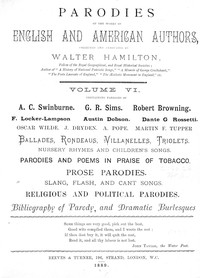
Read on Project GutenbergWalter Hamilton's sixth volume of Parodies of the works of English & American authors (1889) assembles hundreds of imitations targeting poets from Swinburne to Pope, alongside prose parodies, nursery-rhyme travesties, and a substantial bibliography of burlesque. The compiler, a Fellow of the Royal Geographical and Royal Historical Societies, frames the collection as a comprehensive record: 'nearly every Parody of literary merit, or importance, has been mentioned in its pages, whilst some thousands of the best have been given in full.' The volume's preface acknowledges permissions from authors such as F. Locker-Lampson and G. R. Sims, and notes the impossibility of locating some copyright holders.
The excerpt from College Rhymes (1870) titled 'Eremus' mimics Swinburne's characteristic anapestic metre and classical allusions—'Libitina and Clotho to boot'—while applying them to a dead dog encountered by three Oxford or Cambridge students. The parody sustains Swinburne's incantatory repetition ('By the tutors who woefully work us, / By the tutors who don't in the least') and his tendency toward abstract personification ('The desire of an aimless flirtation / Is more than the wisdom of years'). Yet the subject matter is deliberately bathetic: a 'corse, of the brute' prompts mock-heroic invocations and a lament that 'the water of Lethè were powerless / To cleanse from the rust of the years.' The poem's final stanza shifts to decay ('Thou shalt swell with thy gases, and ranker / And ranker shall grow thy perfume'), undercutting Swinburne's usual solemnity with scatological humour.
A second Swinburne parody, from the Century Magazine (1883), exaggerates the poet's alliterative and alexandrine style. The opening lines—'With flow exhaustless of alliterate words, / And rhymes that mate in music glad as birds'—self-consciously announce the technique being mocked. The parody reproduces Swinburne's compound adjectives ('emerald fire,' 'imperious seas') and his fondness for mythological references ('Meleager splendid as the sun / Shrank to a star'). A note in the original publication wryly observes: 'As to any meaning to be attached to the lines each reader is perfectly at liberty to make what sense out of them he can.' This disclaimer highlights a common criticism of Swinburne's verse: that sound sometimes overwhelms sense. The parody's speaker claims to 'sound one sole sweet string,' yet the poem's relentless alliteration and anapestic drive suggest a mechanical rather than inspired composition.
Hamilton's preface reveals the scale of his undertaking: the collection required 'an intimate knowledge of English Poetical Literature' and reference to 'many very rare and scarce books, English, American, and Colonial.' He thanks contributors including Cuthbert Bede, T. F. Dillon Croker, and Gleeson White, and notes that 'in nearly every case the permission of the authors has been obtained.' The volume's table of contents lists sections devoted to 'Ballades, Rondeaus, Villanelles, Triolets,' 'Nursery Rhymes and Children's Songs,' 'Parodies and Poems in Praise of Tobacco,' 'Prose Parodies,' 'Slang, Flash, and Cant Songs,' and 'Religious and Political Parodies.' A bibliography of parody and dramatic burlesques closes the volume. Hamilton explicitly addresses librarians, 'Managers of Penny Readings, and Professors of Elocution' as intended users, suggesting the collection served both scholarly reference and practical performance needs.
Readers approaching this volume should treat it as a period-specific anthology rather than a definitive critical edition. Hamilton's annotations are minimal, and the parodies often depend on familiarity with the original works' metre, diction, and cultural standing. The collection is best sampled in short bursts, comparing each parody with its source to appreciate the precise verbal and structural mimicry. The bibliography of burlesque, though dated, offers a useful starting point for tracing the genre's evolution through the nineteenth century.
There’s something tender about how Hamilton lingers over the parodied voices, catching their rhythms just before they falter. It reminds me of the idle rich in that other book, Arcadian Adventures with the Idle Rich — Themes and Context, whose own pretensions feel gently, almost lovingly exposed. Both leave me a little wistful for an era I never knew.
Use these questions to collect your thoughts before moving on.