About 414 minutes
A laugh a day keeps the doctor away — Reading Notes
Science Fiction Utopias
95,021 recorded words. 27 minutes difference from this book's estimate.
View Gutenberg source #69467
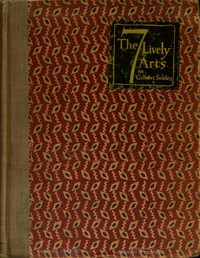
This digital edition of The Seven Lively Arts — Story, Setting & Ideas is described by source-level measurements including 88,829 words, 6 hr 27 min estimated reading time, and 37 detected text sections.
The text analysis averages about 25.6 words per sentence, while the detected sections provide another way to judge how the source is divided.
Project Gutenberg metadata also associates the work with “American wit and humor,” connecting these edition facts with the source record’s subject description.
Explore this collection
These alternatives are selected using recorded categories and estimated reading time.
About 414 minutes
Science Fiction Utopias
95,021 recorded words. 27 minutes difference from this book's estimate.
View Gutenberg source #69467About 419 minutes
Science Fiction Utopias
96,150 recorded words. 32 minutes difference from this book's estimate.
View Gutenberg source #47194About 341 minutes
Science Fiction Utopias
78,306 recorded words. 46 minutes difference from this book's estimate.
View Gutenberg source #39933Search stored excerpts and compare books → Choose by your preferences →
Choices use stored catalog measurements. Estimates vary with reading speed. A shared category is a catalog label, not a claim that two books have the same argument or literary quality.
Search reads excerpt text stored with this catalog and links to its associated Gutenberg record. The connection is stored in the site database; this tool does not recheck that every excerpt is word-for-word identical to that external record. Excerpt search does not cover every chapter and does not verify historical publication dates.
Catalog snapshot checked: 2026-09-25. Coverage: 91 public books, 91 available source excerpts.
Read the complete public-domain text at its original source.
Read on Project GutenbergSeldes opens with a Walter Pater epigraph that frames his project: certain artists 'have a distinct faculty of their own by which they convey to us a peculiar quality of pleasure which we cannot get elsewhere.' The book then launches into a defense of the Keystone comedies, whose 'custodians' are pictured by Ralph Barton. From the first pages, Seldes establishes a tone of affectionate seriousness, treating Mack Sennett's slapstick with the same analytical care he will later apply to Irving Berlin's songs or George Herriman's Krazy Kat.
The table of contents reveals a structure built on specific case studies—Charlie Chaplin, Florenz Ziegfeld, the comic strip 'Krazy Kat'—rather than abstract theory. Seldes moves fluidly between performers, genres, and media, always grounding his claims in observed detail. The excerpts show him dissecting a vaudeville routine by Leon Errol or a song by Irving Berlin with the precision of a music critic, yet his language remains vivid and unpretentious.
The opening chapter, 'The Keystone the Builders Rejected,' immediately signals Seldes's contrarian stance. He treats the Keystone Film Company—producers of early slapstick shorts—as foundational to American comedy, a claim that would have seemed audacious in 1924. The excerpt shows him analyzing the physical comedy of the Keystone Kops not as mere chaos but as a disciplined form: 'the lurch and the fall are worked up into a complete arc of dance steps.'
Seldes's method is to isolate a single performer's gesture and trace its effect. Of Leon Errol's drunk act, he notes the 'loping dance step into which he converts the lurch of the drunkard.' The observation is precise: the comic moment is not the stumble itself but the transformation of that stumble into rhythm. This attention to the craft of popular performance recurs throughout the book.
In the excerpt on Bert Savoy, Seldes demonstrates his ear for vocal nuance. He describes Savoy's 'buzz and pause in the voice—'you muzzt com'over ... you don't know the ha-ff of it, dear-ie'—and notes that 'the interpolations are funnier than the climax.' This is not a general praise of comic timing but a specific observation about Savoy's technique: the digression becomes the point.
Similarly, Seldes praises Harry Kelly's handling of a single word: 'For precisely a minute and a half Kelly played with the word 'bulk'—one saw it registered in his brain, saw an idea germinating.' The analysis treats the performer as a conscious artist, making choices about pause, inflection, and repetition. Seldes's vocabulary—'germinating,' 'conflict of pride and avarice'—borrows from literary criticism, elevating the vaudeville stage to the level of dramatic literature.
Seldes devotes two chapters to newspaper comics, a medium then largely ignored by critics. The excerpt on Krazy Kat (the chapter title: 'The Krazy Kat That Walks by Himself') treats George Herriman's strip as a sustained poetic creation. Seldes's approach is to identify the strip's unique logic: the shifting backgrounds, the invented language, the eternal triangle of Krazy, Ignatz, and Officer Pupp.
He does not summarize plots but instead points to the strip's 'independent commonness'—a phrase he also applies to George Monroe's charwoman. The connection suggests that for Seldes, the vitality of popular art lies in its refusal of refinement. Krazy Kat's 'wildness' and 'unrestraint' are not flaws but the source of its 'immortal' quality. The chapter likely argues that the comic strip, like jazz or vaudeville, achieves a kind of formal perfection through its very roughness.
Several chapters address music: 'Say It with Music,' 'Tearing a Passion to Ragtime,' 'Toujours Jazz.' Seldes treats Irving Berlin and George Gershwin as serious composers, analyzing their rhythmic innovations and their debt to African American musical traditions. The excerpt on Berlin's 'Bananas' (appended to the main text) suggests Seldes's willingness to examine individual songs in detail.
His 'Plan for a Lyric Theatre in America' proposes a synthesis of these popular forms—jazz, vaudeville, comic opera—into a distinctively American art. The excerpts do not reveal the plan's specifics, but the ambition is clear: Seldes wants to build a critical framework that can accommodate both the Ziegfeld Follies and the Metropolitan Opera. The book's structure, moving from Keystone to Krazy Kat to jazz, enacts this integration, treating each form as a 'lively art' worthy of the same attention given to painting or poetry.
Seldes's book rewards a reader who follows his method: watch for the specific gesture, the repeated phrase, the moment of transformation. The excerpts offer a series of close readings—of a drunkard's dance, a comedian's pause, a cartoon cat's walk—that together build a case for the aesthetic seriousness of popular entertainment. A first-time reader might start with the chapters on performers they already know (Chaplin, Jolson, Gershwin) and then follow Seldes's connections to less familiar figures. The book is not a history but a set of arguments, and its pleasure lies in watching a critic make his case with precision and enthusiasm.
Seldes found such tenderness in Charlie Chaplin’s grace, the way a circus clown’s fragile dignity outshone the grand stage. That same fond mischief lives in Inside the Classic, where familiar heroes stumble into affectionate mockery. Parodies of the works of English & American authors, vol. IV — Inside the Classic holds its own quiet wink at seriousness, a shared, knowing smile across the decades.
Use these questions to collect your thoughts before moving on.