About 67 minutes
Mr. Punch's After-Dinner Stories — Text and Context
Adventure Picaresque Fiction
15,183 recorded words. 27 minutes difference from this book's estimate.
View Gutenberg source #33824
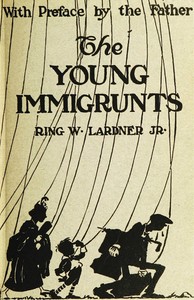
The catalog record for The young immigrunts — Story, Setting & Ideas provides practical reading context through 9,179 words, 40 min estimated reading time, and 17 detected text sections.
The text analysis averages about 23.4 words per sentence, while the detected sections provide another way to judge how the source is divided.
Project Gutenberg metadata also associates the work with “American wit and humor,” connecting these edition facts with the source record’s subject description.
Explore this collection
These alternatives are selected using recorded categories and estimated reading time.
About 67 minutes
Adventure Picaresque Fiction
15,183 recorded words. 27 minutes difference from this book's estimate.
View Gutenberg source #33824About 69 minutes
Adventure Picaresque Fiction
15,745 recorded words. 29 minutes difference from this book's estimate.
View Gutenberg source #45748About 73 minutes
Adventure Picaresque Fiction
16,752 recorded words. 33 minutes difference from this book's estimate.
View Gutenberg source #52365Search stored excerpts and compare books → Choose by your preferences →
Choices use stored catalog measurements. Estimates vary with reading speed. A shared category is a catalog label, not a claim that two books have the same argument or literary quality.
Search reads excerpt text stored with this catalog and links to its associated Gutenberg record. The connection is stored in the site database; this tool does not recheck that every excerpt is word-for-word identical to that external record. Excerpt search does not cover every chapter and does not verify historical publication dates.
Catalog snapshot checked: 2026-09-25. Coverage: 91 public books, 91 available source excerpts.
Read the complete public-domain text at its original source.
Read on Project GutenbergThe narrator of The Young Immigrunts is four years old and writes with a phonetic spelling and syntax that turns every road incident into a small comedy. The preface, signed by “The Father,” claims the manuscript was found in late 1919 and that the story is “substantially true” except for a few corrections—including the note that the father’s witty speeches have been “garbled and twisted” by a child’s memory. This framing sets up the central tension: a child’s earnest, misspelled report versus the adult world’s impatience and absurdity.
The narrator’s voice is the book’s engine. In the first chapter, the child describes his parents: “My parents are both married and ½ of them are very good looking. The balance is tall and skiny and has a swarty complexion with moles.” The father’s physical flaws are catalogued with the same bluntness as his temper. When the family stops for a car part, the narrator reports that “my father lost his temper and when we finley immerged he was barking like a dog.” The father’s outbursts are a running gag, but the child never judges them—just records them as facts. This flat, uncomprehending tone is what makes the humor work.
Every stop brings a new character, often introduced with a physical quirk. In Hudson, a “man of 12 years” hops onto the running board and offers directions; the father mutters, “I must be a grate favorite in Hudson.” The hotel clerk is “senile,” the landlady appears “in her bear feet” and “sredded night gown.” A sailor who was supposed to ride with them is kicked out for not paying. The child’s spelling—grate for great, brekfus for breakfast, costly moter for car—turns every encounter into a slightly off-kilter scene. The illustrations by Gaar Williams, listed in the front matter, reinforce these caricatures.
The trip’s structure is a chain of small disasters. The family starts “gaily” but soon faces locked garages, bad food, and lost tempers. In chapter 8, the father retrieves the car after a half-hour delay, and the narrator notes he “used the brains god gave me” to find the garage owner’s house. At the Beekman Arms, the mother reads that it’s the oldest hotel in America; the father replies, “The eggs tastes all right.” The journey’s geography—Erie Lake, Syracuse, Hudson, Yonkers—is marked by mileage in the chapter titles, but the real distance is measured in frustrations. The child never complains, which makes the father’s irritation seem both comic and lonely.
The preface is essential to reading the book. The father claims the story is true except for three points: his own temper is exaggerated, his witty speeches are garbled, and more gas stops were made than recorded. This disclaimer turns the entire narrative into a joke at the father’s expense—he is both the editor and the butt of the humor. The child’s misspellings (like immigrunts for immigrants) are preserved, but the father has “copied the entire work with a fresh ribbon.” The result is a layered text: a child’s voice filtered through an adult’s typewriter, with the father pretending to be objective while defending himself.
The book’s brevity—under 10,000 words—makes it a quick read, but its humor rewards attention to the child’s word choices and the father’s deadpan replies. The preface invites readers to decide which parts are true and which are garbled. For those interested in American road comedy or unreliable narrators, this is a compact, peculiar example.
Reading about that four-year-old watching her father’s temper flare in the car, I thought of my own childhood backseat, the silences thick as gravel. We never said what we meant, just like those misspelled notes. Mr. Punch's After-Dinner Stories — Text and Context once gave me that same ache—laughter hiding something sharper underneath, the joke never quite landing. Funny how the smallest voices carry the heaviest truths.
Capture what you thought, learned, and would like to remember.