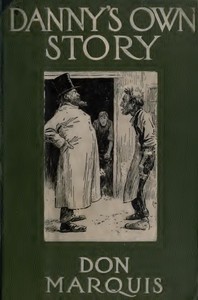
Don Marquis's Danny's Own Story opens with a narrator who cannot claim a last name, a detail that immediately signals the book's preoccupation with identity and circumstance. Danny's voice—rendered in a dense, phonetic dialect—is both the novel's primary engine and its central puzzle. The first chapter establishes a comic, aggrieved tone as Danny recounts how Old Hank Walters and his wife Elmira discovered him as a baby in a basket, a scene that mixes farce (Hank's drunken stumble) with deadpan observation. But the excerpts also reveal a capacity for sudden, unadorned violence: a later passage describes a nighttime raid, a gunshot, and a wounded rider who challenges Danny to finish him off. This juxtaposition of folksy humor and stark action suggests a narrative that shifts gears abruptly, moving from the rhythms of small-town gossip to the tension of a standoff.
A Voice That Refuses Polish
The most immediate feature of Danny's Own Story is its narrator's language. Danny speaks in a thick, unvarnished dialect: “aggervation” for aggravation, “confuddled” for confused, “lickered up” for drunk. This is not a neutral transcription but a deliberate stylistic choice that gives Danny a distinct personality—irreverent, stubborn, and sharply observant. His grammar bends to his will: “I might of had one jest as well as not if Old Hank Walters hadn't been so all-fired, infernal bull-headed.” The effect is both comic and distancing; readers must adjust to the rhythm of his speech. Marquis uses this voice to control pace: when Danny is recounting domestic squabbles, the sentences loop and repeat, mimicking the circular arguments of Hank and Elmira. But when the action turns violent, the dialect remains but the syntax tightens, as in the scene where Danny picks up the fallen revolver: “I picked it up in the road jest a few feet from his shot-gun, and stood there with it in my hand, looking down at him.” The voice does not disappear; it adapts.
Pace Shifts: From Domestic Comedy to Sudden Violence
The excerpts show two distinct modes. The opening chapters move at a leisurely, anecdotal pace, filled with digressions about Hank's drinking, Elmira's temper, and Danny's own wry commentary. The prose lingers on details like the rubber tube on the baby bottle or the shawl later worn to meeting. But the later excerpt—a night scene involving a gang of riders, a fire, and a shooting—introduces a different tempo. Sentences shorten: “The hoss jumped forward at the shot, and the feller swayed sideways and dropped his gun and lost his stirrups and come down heavy on the ground.” The description becomes cinematic, tracking movement across the square, the sound of hoofbeats, the sudden crack of a gun. Danny's narration shifts from reflective to immediate; he notes his own fear (“I laid low on them boards”) but also his resolve (“If they come, I didn't want to be found running”). This change in pace is not merely technical—it signals a world where domestic squabbles and mortal danger coexist, and where Danny must navigate both.
Recurring Details: The Basket, the Shawl, the Mask
Marquis plants small, tangible objects that recur across the excerpts, linking Danny's past to his present. The basket in which he was found reappears in memory; the shawl Elmira appropriated becomes a marker of her practicality. In the later scene, a mask—slipped down to reveal a young face—echoes the theme of hidden identity. Danny himself is a foundling, and the masked riders are anonymous; both are defined by what they conceal. The narrator's attention to these details is precise: the mask has “some hair onto the bottom of it to look like a beard,” and when it slips, “it hung loose around his neck by the string.” These observations are not decorative; they ground the story in a physical world where objects carry weight. The rubber tube on the bottle, the shawl, the mask, the dropped revolver—each is a clue to character or circumstance. Danny's voice may be folksy, but his eye is forensic.
The Narrator's Limited Knowledge
Danny repeatedly acknowledges that he is reporting events secondhand or from an incomplete perspective. In the first chapter, he notes: “All of which, you understand, I am a-telling you from hearsay, as the lawyers always asts you in court.” Later, during the night raid, he admits he does not know who fired the shot or why: “I s'pose they was some one hid in the lumber piles, where the street crossed the railway, besides myself.” This self-imposed limitation keeps the reader inside Danny's consciousness, never granting omniscience. The narrative pace is thus tied to what Danny sees, hears, and infers. When he cannot see, the story pauses; when he acts, it accelerates. This technique gives the novel an episodic, picaresque quality, where events are filtered through a narrator who is both participant and observer, and who often admits he does not have the full picture.
Readers approaching Danny's Own Story should listen closely to the narrator's voice, which carries the novel's humor, tension, and pathos. The dialect is not a barrier but a lens; it shapes how events are perceived and remembered. Pay attention to the objects Danny notices—the basket, the shawl, the mask—as they often carry more weight than the characters themselves acknowledge. And note the shifts in sentence rhythm: when the prose tightens, the world has suddenly become dangerous. This is a book that moves between laughter and unease, and its narrator is the only guide you have.
I finished Danny's Own Story — Reading Companion the other evening, and it left me thinking about how a plain voice can carry so much weight. Danny’s stumbling honesty stayed with me, that quiet way he notices the world without quite knowing what to make of it. It reminded me, oddly, of the gentle observations tucked inside Animal Analogues: Verses and Illustrations — Edition Insights—not the stories themselves, but that same patient, unforced attention to small creatures and their own strange dignity.