About 644 minutes
The Monikins — Themes and Context
Fantasy Juvenile Worlds
147,923 recorded words. 396 minutes difference from this book's estimate.
View Gutenberg source #4092
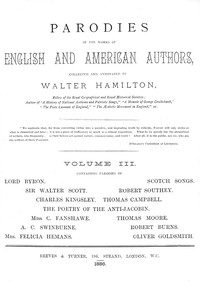
For Parodies of the works of English & American authors, vol. III — Reading Notes, the stored edition analysis reports 239,041 words, 17 hr 20 min estimated reading time, and 59 detected text sections.
The text analysis averages about 20.2 words per sentence, while the detected sections provide another way to judge how the source is divided.
Project Gutenberg metadata also associates the work with “Parodies,” connecting these edition facts with the source record’s subject description.
Explore this collection
These alternatives are selected using recorded categories and estimated reading time.
About 644 minutes
Fantasy Juvenile Worlds
147,923 recorded words. 396 minutes difference from this book's estimate.
View Gutenberg source #4092About 353 minutes
Fantasy Juvenile Worlds
81,052 recorded words. 687 minutes difference from this book's estimate.
View Gutenberg source #51925About 304 minutes
Fantasy Juvenile Worlds
69,847 recorded words. 736 minutes difference from this book's estimate.
View Gutenberg source #41249Search stored excerpts and compare books → Choose by your preferences →
Choices use stored catalog measurements. Estimates vary with reading speed. A shared category is a catalog label, not a claim that two books have the same argument or literary quality.
Search reads excerpt text stored with this catalog and links to its associated Gutenberg record. The connection is stored in the site database; this tool does not recheck that every excerpt is word-for-word identical to that external record. Excerpt search does not cover every chapter and does not verify historical publication dates.
Catalog snapshot checked: 2026-09-25. Coverage: 91 public books, 91 available source excerpts.
Read the complete public-domain text at its original source.
Read on Project GutenbergWalter Hamilton's third volume of Parodies of the works of English & American authors opens with a defense of parody as 'a critical exposition' aimed at 'what is chimerical and false,' quoting Isaac D'Israeli. The collection targets major figures—Byron, Scott, Burns, Kingsley, Moore, Swinburne—and includes a substantial section on The Anti-Jacobin. Hamilton's index lists originals in small capitals and parodists in italics, signaling a scholarly apparatus beneath the humor.
The excerpts reveal how parodists twist familiar structures. 'The Graves of a Household' becomes a catalogue of railway deaths: 'They sucked their pap spoons side by side, / They filled one house with shines— / Their graves are lying severed wide, / By many railway lines.' The original's domestic pathos is replaced by mechanical violence. Similarly, 'The Happy Land' transforms a hymn into a music-hall quiz: 'Is it at the Gaiety—Vaudeville—Strand— / Or where, secure from the public gaze, / Mr. Buckstone privately Hamlet plays?' The parodist relies on the reader's knowledge of the original to register the incongruity.
Many parodies anchor themselves in contemporary events. 'The Graves of a Household' lists specific railway lines—'the broad gauge line which goes / To Exeter,' 'the Eastern Counties line'—and grisly accidents: 'They ran into a luggage train, / And mincemeat of him made.' 'The Happy Land' mocks theatrical censorship and specific actors: 'the Lord Chamberlain weakly tries / To interfere with the actors' guise.' A parody of 'The Pilgrim Fathers' asks about 'the dominions of Brigham Young' and 'Long John Wentworth,' blending Western expansion with Mormon polygamy. These references, while obscure today, show parody as a form of topical journalism.
Hamilton devotes a full section to The Poetry of the 'Anti-Jacobin', a late-1790s periodical that used parody to attack radical ideas. The index lists 'La Sainte Guillotine, Song; The Progress of Man, after Mr. R. Payne Knight; Chevy Chase; The Loves of the Triangles, after Dr. Darwin; Brissot's Ghost, after Glover's Ballad.' These pieces mock Enlightenment optimism and revolutionary fervor by mimicking the styles of their proponents. The inclusion of 'The Rovers' by George Canning and 'The University of Gottingen' shows how parody served as a conservative literary weapon, targeting both poetic excess and political ideology.
The excerpts cover only a fraction of Hamilton's 239,041-word volume. The index promises parodies of Byron, Scott, Southey, Kingsley, Campbell, Moore, Swinburne, Burns, Hemans, and Goldsmith, but the provided text samples only a few. The 'He Never Wrote Again' fragment—'His hope of publishing went down, / The sweeping press rolled on'—suggests a meta-parody about rejection, but its full context is absent. Readers should treat the excerpts as a sampler, not a summary. The volume's structure—alphabetical by original author, with scholarly notes—invites browsing rather than linear reading.
Hamilton's collection rewards readers who approach it as a historical document of Victorian literary taste and political satire. The parodies work best when the originals are known; consulting the referenced poems alongside this volume deepens the humor. The index and D'Israeli's introductory chapter provide a framework, but the real pleasure lies in the unexpected juxtapositions—a hymn turned into a railway accident, a patriotic poem into a critique of Mormon Utah.
Hamilton's parodies amused me because they loved their targets enough to twist them gently, a fond mischief echoing through the years. That same playful kinship breathes in Some Adventures of Mr. Surelock Keys — Text and Context, where detective wit becomes its own quiet tribute. Both volumes sit on my shelf like old friends trading knowing smiles.
A brief reflection can help important ideas stay with you longer.